



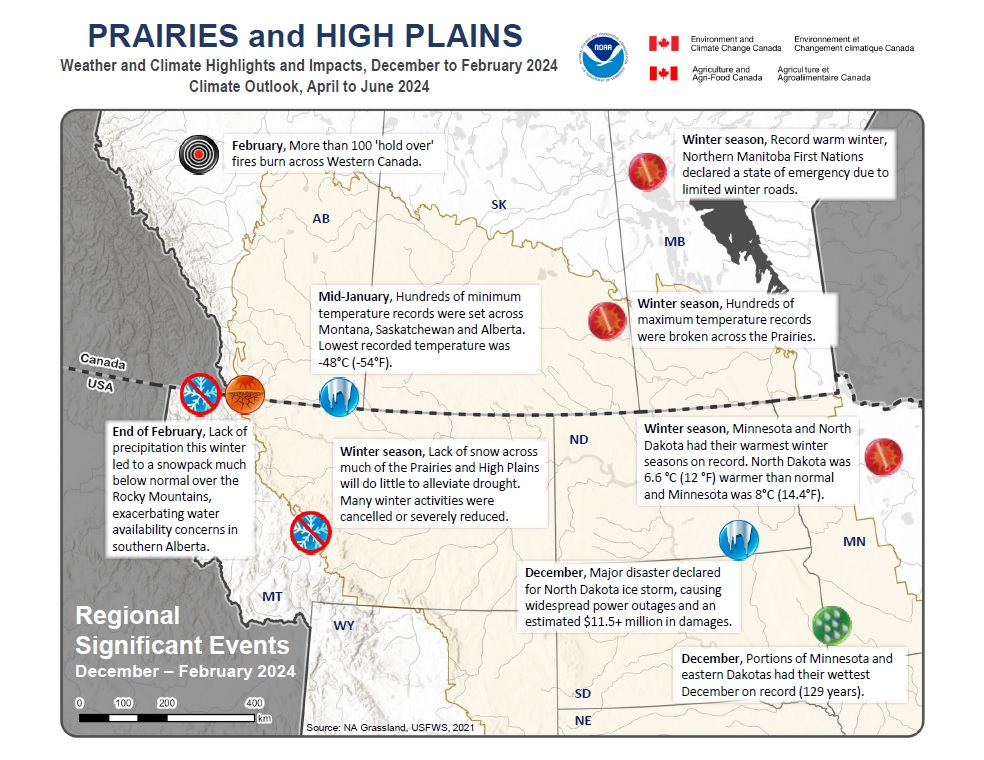
Quarterly Climate Impacts and Outlook for the Canadian and U.S. Prairies and High Plains for December 2023–February 2024, with an outlook for April–June 2024. Dated March 2023.
The Prairies and High Plains saw warmer than normal temperatures, with the eastern half notably warmer than the rest of the region. Much drier than normal conditions were observed across the region in the bordering states and provinces, including inland areas such as the northern Prairies, parts of Montana, Wyoming, and the Dakotas.
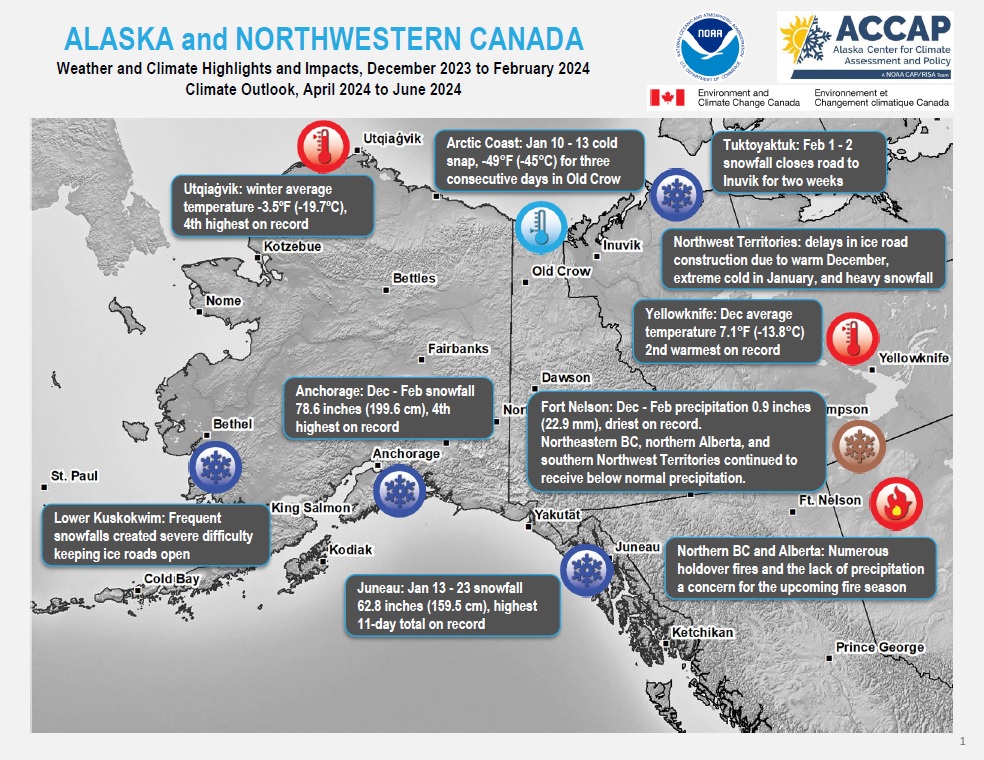
Quarterly Climate Impacts and Outlook for Alaska and Northwestern Canada for December 2023–February 2024, with an outlook for April–June 2024. Dated March 2024.
Environment and Climate Change Canada, NOAA, and partners created these climate outlooks to inform the public about recent climate impacts within their respective regions. Each regional report contains easy-to-understand language, and anyone can access them through the U.S. Drought Portal.
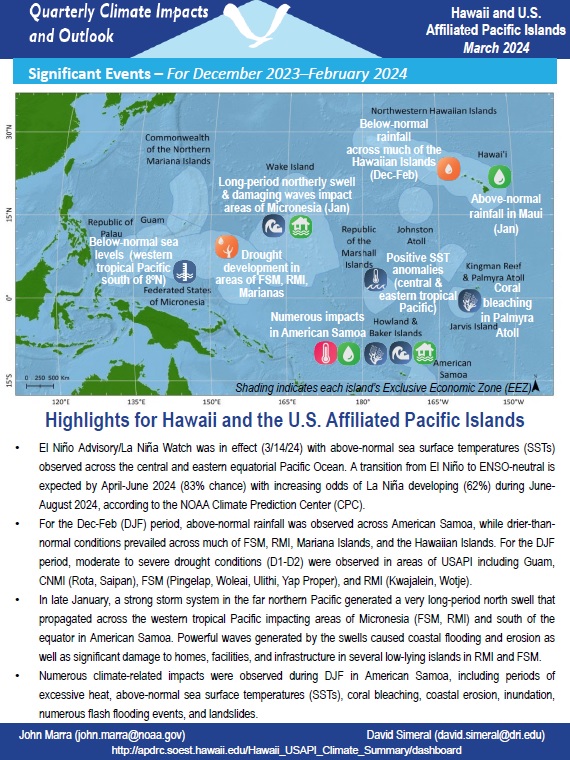
Quarterly Climate Impacts and Outlook for the Pacific Region for December 2023–February 2024. Dated March 2024.
For the Dec-Feb (DJF) period, above-normal rainfall was observed across American Samoa, while drier-than-normal conditions prevailed across much of FSM, RMI, Mariana Islands, and the Hawaiian Islands. For the DJF period, moderate to severe drought conditions (D1-D2) were observed in areas of USAPI including Guam, CNMI (Rota, Saipan), FSM (Pingelap, Woleai, Ulithi, Yap Proper), and RMI (Kwajalein, Wotje).
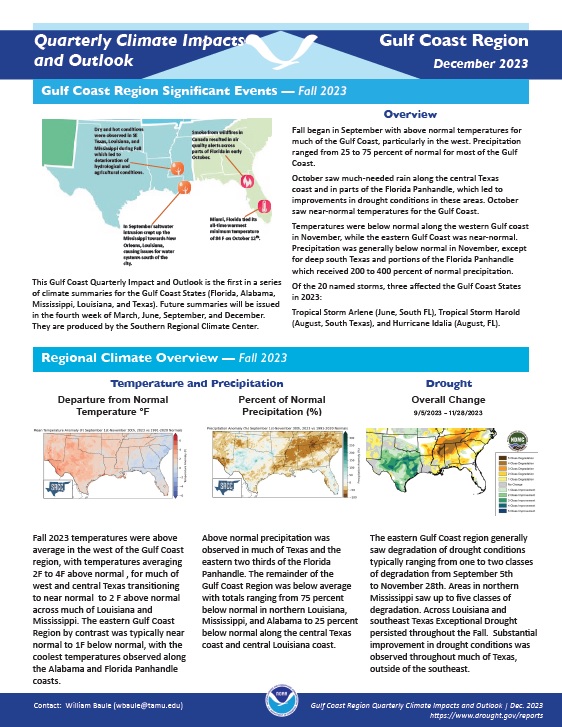
Quarterly Climate Impacts and Outlook for the Gulf Coast Region for September–November 2023. Dated December 2023.
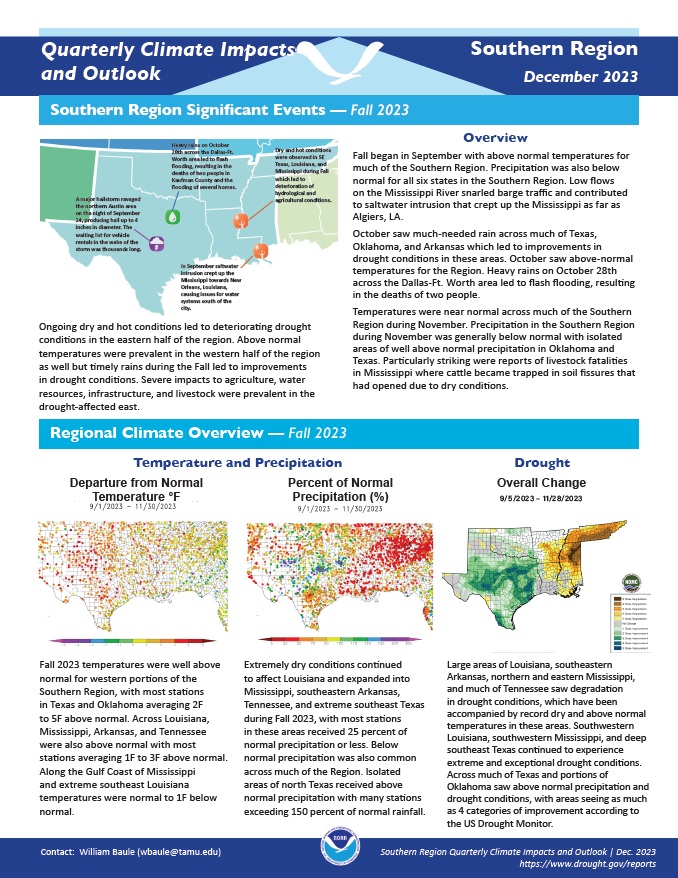
Quarterly Climate Impacts and Outlook for the Southern Region for September–November 2023. Dated December 2023.
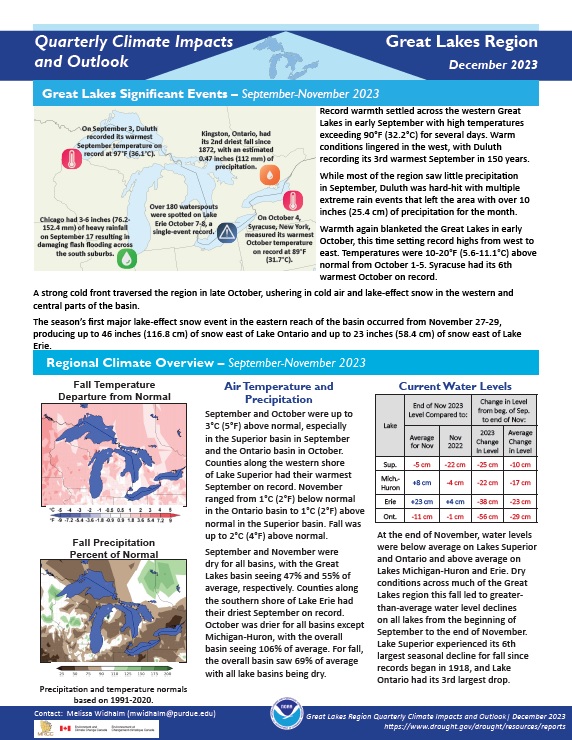
Quarterly Climate Impacts and Outlook for the Great Lakes Region for September–November 2023. Dated December 2023.
Fall temperatures in the region were up to 2°C (4°F) above normal. The overall basin saw 69% of average precipitation with all lake basins being dry.
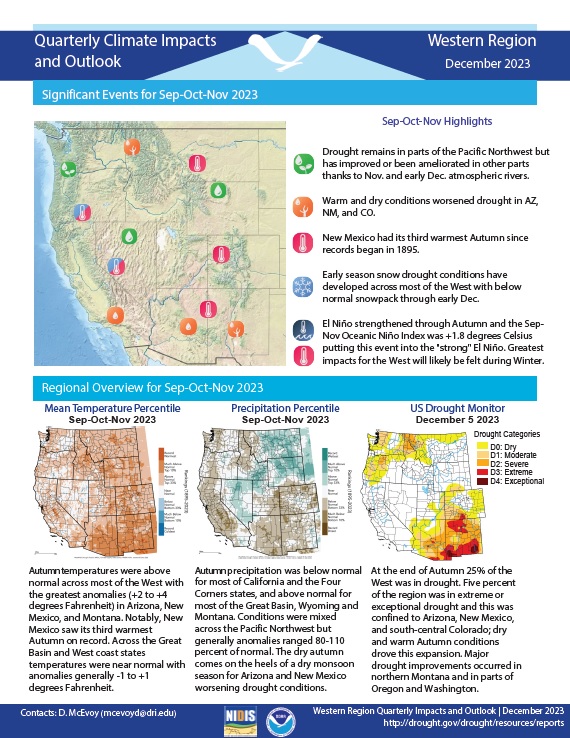
Quarterly Climate Impacts and Outlook for the Western Region for September–November 2023. Dated December 2023.
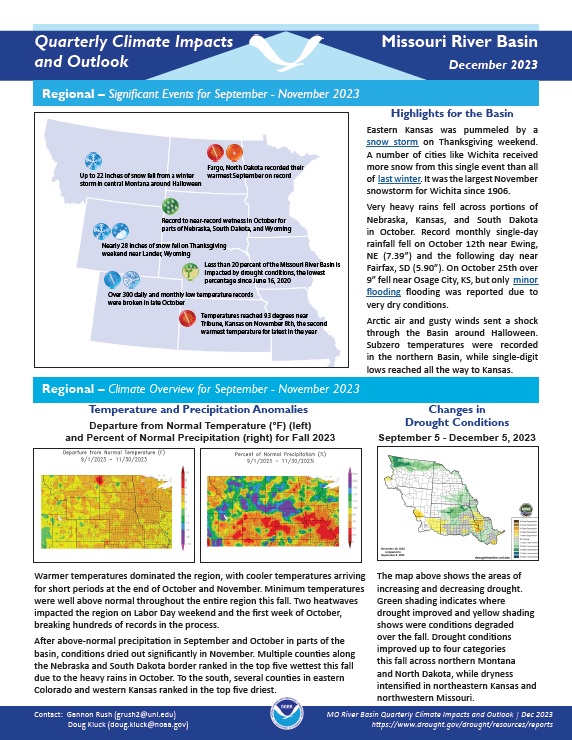
Quarterly Climate Impacts and Outlook for the Missouri River Basin for September–November 2023. Dated December 2023.
Warmer temperatures dominated the region, with cooler temperatures arriving for short periods at the end of October and November. Minimum temperatures were well above normal throughout the entire region this fall. After above-normal precipitation in September and October in parts of the basin, conditions dried out significantly in November.
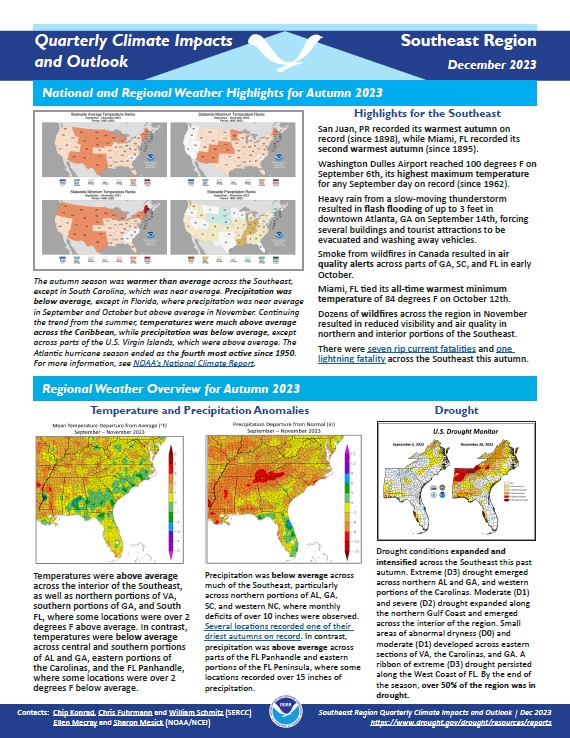
Quarterly Climate Impacts and Outlook for the Southeast and Caribbean Region for September–November 2023. Dated December 2023. (Updated February 2024 to add Spanish translation of Caribbean information.)
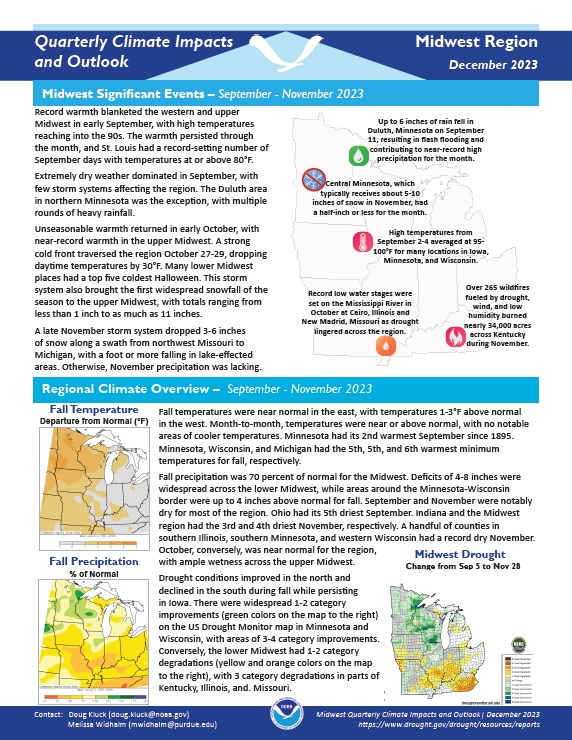
Quarterly Climate Impacts and Outlook for the Midwest Region for September–November 2023. Dated December 2023.
Fall temperatures were near normal in the east, with temperatures 1–3°F above normal in the west. Month-to-month, temperatures were near or above normal, with no notable areas of cooler temperatures. Fall precipitation was 70% of normal for the Midwest. Deficits of 4–8 inches were widespread across the lower Midwest, while areas around the Minnesota-Wisconsin border were up to 4 inches above normal for fall.