



About the Data: Upper Missouri River Basin Soil Moisture and Snowpack Dashboard
 | Data Coverage: Regional Data Type: Land-based Station Period of Record: 2023–Present File Formats: images, geoJSON Key Partners: NOAA’s National Integrated Drought Information System (NIDIS) and National Centers for Environmental Information (NCEI), Montana Mesonet, Nebraska Mesonet, Mesonet at South Dakota State University, North Dakota Agricultural Weather Network (NDAWN), Wyoming Mesonet, U.S. Army Corps of Engineers |
Note: The content and functionality of this dashboard are for demonstration purposes only and are not finalized, including some simulated data. Please read all map descriptions carefully.
Under Congressional direction, NOAA's National Integrated Drought Information System (NIDIS) is leading the Upper Missouri River Basin Data Value Study, an interagency study of the value of the data from the Upper Missouri River Basin Soil Moisture and Plains Snow Monitoring Build-Out to support improvements to water resource models, drought monitoring capabilities, and other applications. One goal of this study is to produce publicly-available, basin-wide soil moisture and snowpack data and maps on Drought.gov to support the U.S. Drought Monitor authors and contributors.
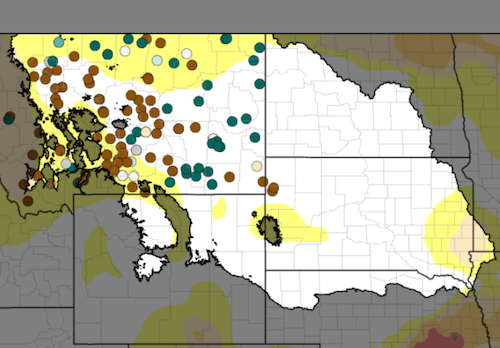
To facilitate access to the diverse datasets necessary to fully monitor basinwide hydrological conditions, the U.S. Drought Portal team created an interactive dashboard. The Drought Portal team ingests station-based soil moisture and snowpack data from the five state mesonets in the Upper Missouri River Basin (UMRB)—Montana, Nebraska, North Dakota, South Dakota, and Wyoming. Data are ingested via Synoptic, who is contracted by the National Weather Service’s National Mesonet Program to develop the UMRB data access platform. Soil moisture and snowpack data are valid through 12z each Tuesday, and are displayed in actionable maps. Overlays, such as the U.S. Drought Monitor or snow water equivalent (SWE), are also available to provide additional context to station-level observations that inform drought monitoring and decision-making in the region.
Available maps will include:
- Soil moisture (volumetric water content) change maps for 1, 4, 8, and 26 weeks, which can show important trends in evolving conditions
- Topsoil: Average of 2- and 4-inch depth observations
- Subsoil: Average of 8- and 20-inch depth observations
- Total Column: Average of 2-, 4-, 8-, and 20-inch depth observations
- Categorical soil moisture, which places mean volumetric water content (VWC) for topsoil, subsoil, and total column layers into commonly used agricultural conditions (e.g., very short, adequate) based on the properties of the soil (e.g., wilting point and field capacity).
- Snow depth current conditions (inches).
Additional maps, such as fractional available water (FAW) and snow water equivalent (SWE), are planned for future phases of development. Because of the current short period of record for this new network, VWC anomalies or percentiles are not yet available.
For additional soil moisture and snowpack data and information, visit the five UMRB state mesonets, or view time series graphs of the data on the U.S. Army Corps of Engineers UMRB Monitoring Network page.
Access
UMRB Soil Moisture & Snowpack Dashboard
UMRB Monitoring Network Data: View and download time series graphs of soil moisture and snow data, as well as photos of the mesonet stations.
View soil moisture and snowpack data from the UMRB state mesonets: