
Quantifying the Relative Importance of Multiple Drought Indicators in the U.S. Drought Monitor as a Function of Location and Time of Year

The goal of this project was to determine the roles of multiple physical indicators in replicating the drought conditions in the U.S. Drought Monitor and quantify the information explained by each indicator as a function of location and season.
In the study, the researchers looked at 113 indicators of drought, including in situ (observation-based), modeled, and remote-sensed data across a variety of timescales (from 1 week to 72 months). The researchers used an information theoretic measure, mutual information, to compare these 113 indicators to U.S. Drought Monitor data from 2006-2019. They broke these results down by geographic region and season (spring, summer, fall, winter, and all seasons).
The researchers calculated the mutual information for each of the 113 indicators individually, as well as for several groups of indicators (e.g., all remote-sensing indicators combined). To do this, they began with historical percentiles for each of the indicators and calculated the mutual information with the U.S. Drought Monitor. Researchers then normalized these values, so they could compare results across different locations. The resulting normalized mutual information is called fractional information. They used climate division–resolution data to calculate the fractional information for six regions across the continental U.S., which mostly align with NOAA's Regional Climate Centers: High Plains, Midwest, Northeast, South, Southeast, and West.
The results of this research highlight indicators—and timescales—that may be relevant to monitor drought in a given region and season. They also highlight regional and seasonal differences in indicator performance that can inform future drought monitoring and planning efforts. If local stakeholders can have information about which drought indicators are most critical for monitoring and predicting evolving droughts in their regions, then they can better prepare for and mitigate existing droughts.
Research Snapshot
Results of This Research
Peer-Reviewed Publications:
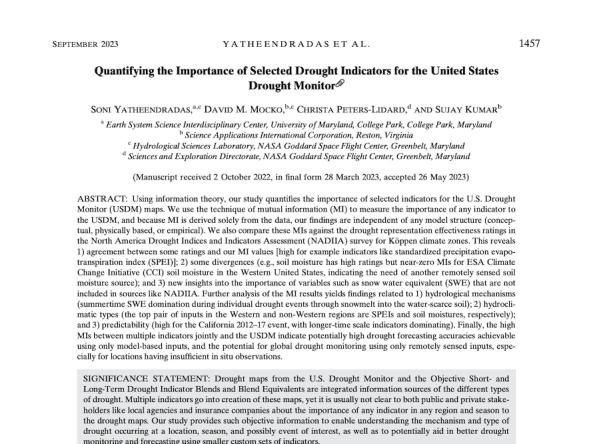
- Yatheendradas, S., D. M. Mocko, C. Peters-Lidard, and S. Kumar. 2023. "Quantifying the Importance of Selected Drought Indicators for the United States Drought Monitor." Journal of Hydrometerology 24(9), 1457–1478.
Public-Facing Communications:
- Analyzing Drought Indicator Relevance by Region and Season: Key Takeaways from NASA-Led Research: Story Map overview of the research methodology, key findings for each region and season, and information on other related drought indicator research.
- Explore the Data: Drought Indicator Relevance by Region and Season: Interactive data table allowing users to explore the research results by region and season.
Related Data & Maps
A team of scientists at the NASA Goddard Space Flight Center conducted research to quantify the relative importance—or “drought explainability”—of specific indicators with respect to the