



This document was developed in response to the identification of metadata and data quality guidelines for in situ soil moisture monitoring as a top priority for the National Coordinated Soil Moisture Monitoring Network (NCSMMN) at the National Soil Moisture Workshop in 2022.
NOAA’s National Integrated Drought Information System (NIDIS) and Physical Sciences Laboratory are partnering with the California State Climatologist/California Department of Water Resources, NOAA’s National Weather Service and National Centers for Environmental Information, and the California-Nevada Adaptation Program (a NOAA CAP team) on the Sector-Specific Drought Early Warning Outlook – Southern California Pilot.
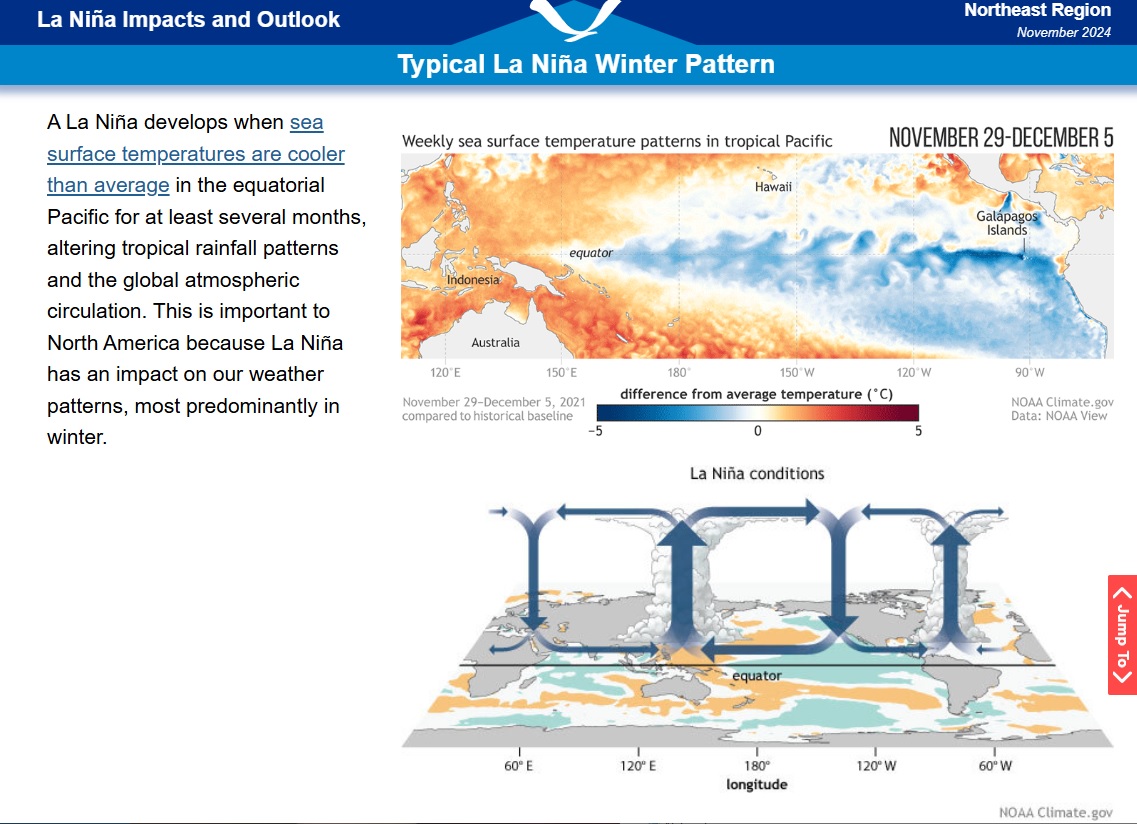
This web page provides information on the typical La Niña winter pattern; the La Niña outlook; potential winter and spring impacts; and comparisons of conditions during previous La Niña years for the Northeast region. Updated November 2023.
NOAA’s Regional Climate Services Program created these Outlooks to inform the public about climate impacts within their respective regions. Each regional report contains easy-to-understand language, and anyone can access them through the U.S. Drought Portal.
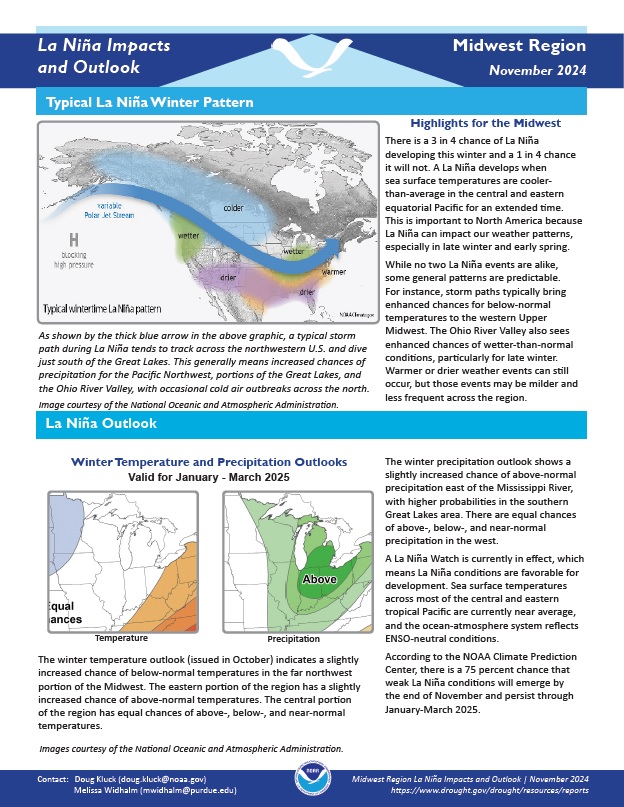
This report provides information on the typical La Niña winter pattern; the La Niña outlook; potential impacts; and comparisons of conditions during previous La Niña years for the Midwest U.S. Updated November 2024.
NOAA’s Regional Climate Services Program created these outlooks to inform the public about climate impacts within their respective regions. Each regional report contains easy-to-understand language, and anyone can access them through the U.S. Drought Portal.
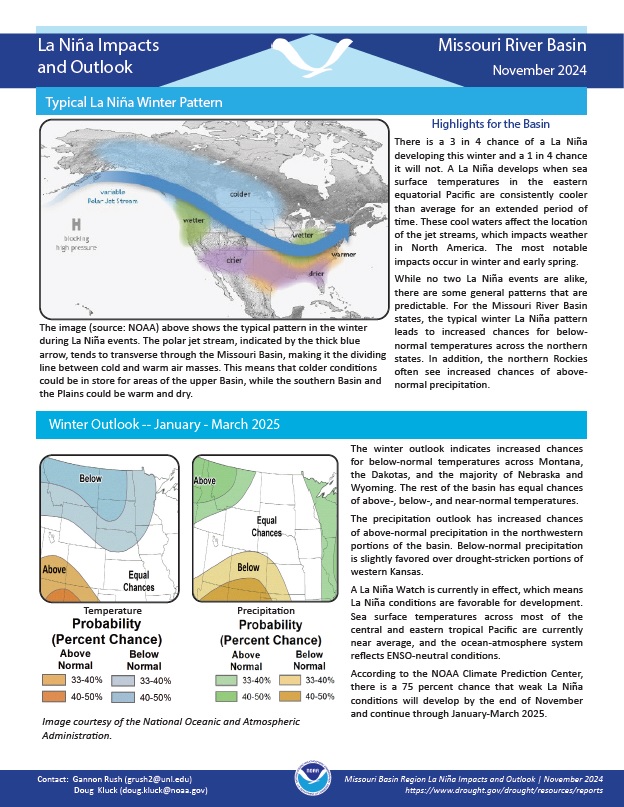
This handout provides information on the typical La Niña winter pattern; the La Niña outlook; potential winter and spring impacts; and comparisons of conditions during previous La Niña years for the Missouri River Basin. Updated November 2024.
NOAA’s Regional Climate Services Program created these outlooks to inform the public about climate impacts within their respective regions. Each regional report contains easy-to-understand language, and anyone can access them through the U.S. Drought Portal.
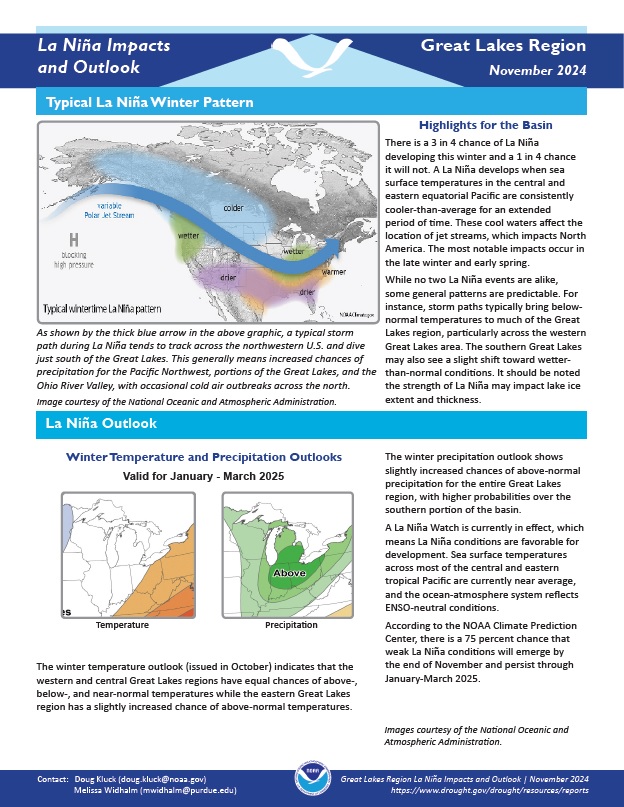
This handout provides information on the typical La Niña winter pattern; the La Niña outlook; potential winter and spring impacts; and comparisons of conditions during previous La Niña years for the Great Lakes region. Updated November 2024.
NOAA’s Regional Climate Services Program created these Outlooks to inform the public about climate impacts within their respective regions. Each regional report contains easy-to-understand language, and anyone can access them through the U.S. Drought Portal.
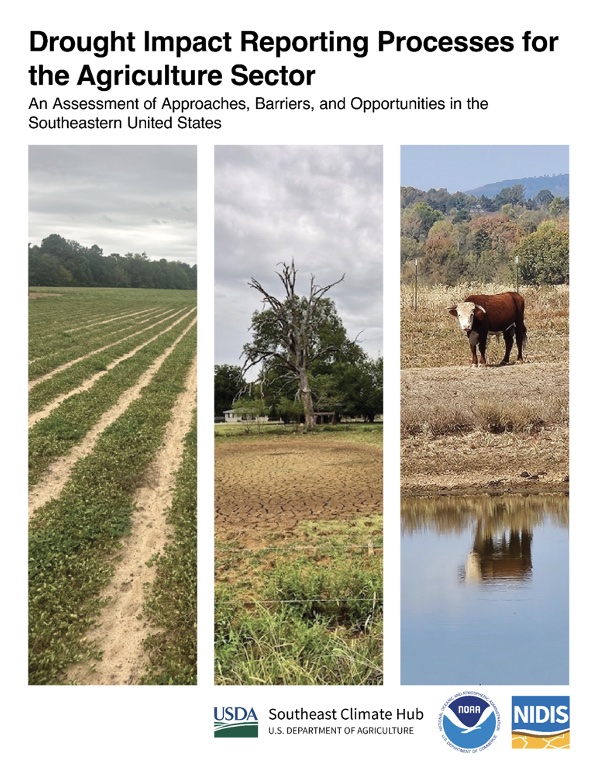
Despite the water-rich nature of the southeastern U.S., extended and intense dry periods intermittently occur across the region leading to reduced soil moisture levels and surface water supplies. These drought periods affect the landscape at different scales, with agriculture experiencing impacts earlier than other sectors
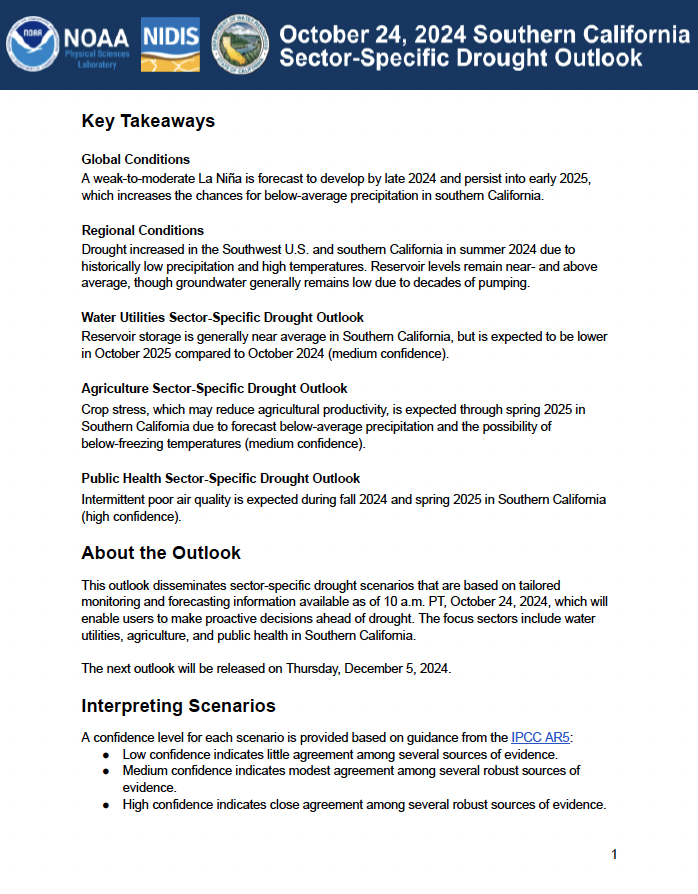
NOAA’s National Integrated Drought Information System (NIDIS) and Physical Sciences Laboratory are partnering with the California State Climatologist/California Department of Water Resources, NOAA’s National Weather Service and National Centers for Environmental Information, and the California-Nevada Adaptation Program (a NOAA CAP team) on the Sector-Specific Drought Early Warning Outlook – Southern California Pilot.
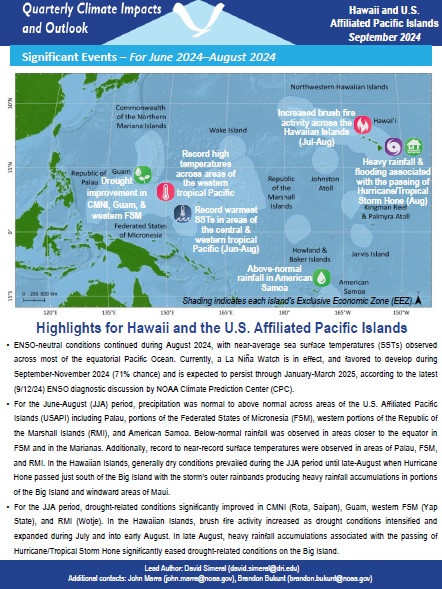
Quarterly Climate Impacts and Outlook for the Pacific Region for June–August 2024. Dated September 2024.
For the June-August period, precipitation was normal to above normal across areas of the U.S. Affiliated Pacific Islands (USAPI) including Palau, portions of the Federated States of Micronesia (FSM), western portions of the Republic of the Marshall Islands (RMI), and American Samoa. Below-normal rainfall was observed in areas closer to the equator in FSM and in the Marianas.
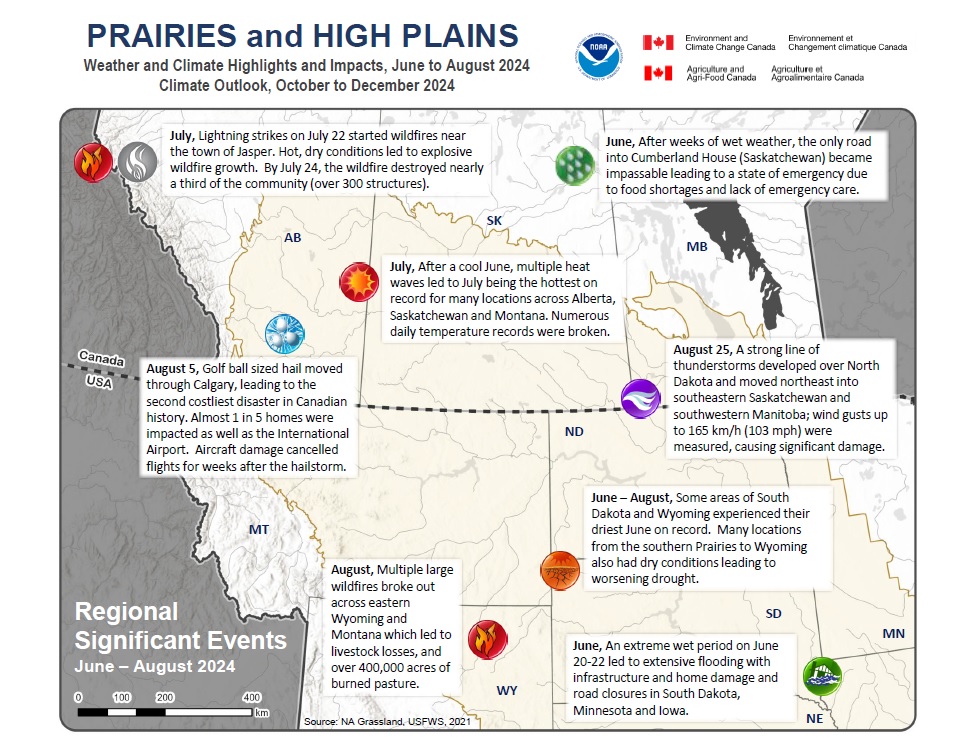
Quarterly Climate Impacts and Outlook for the Canadian and U.S. Prairies and High Plains for June–August 2024, with an outlook for October–December 2024. Dated September 2024.