Drought Expands in Texas and Oklahoma. A Winter Storm Is Coming, But Hot, Dry Weather in February-April Could Worsen Drought.
Key Points
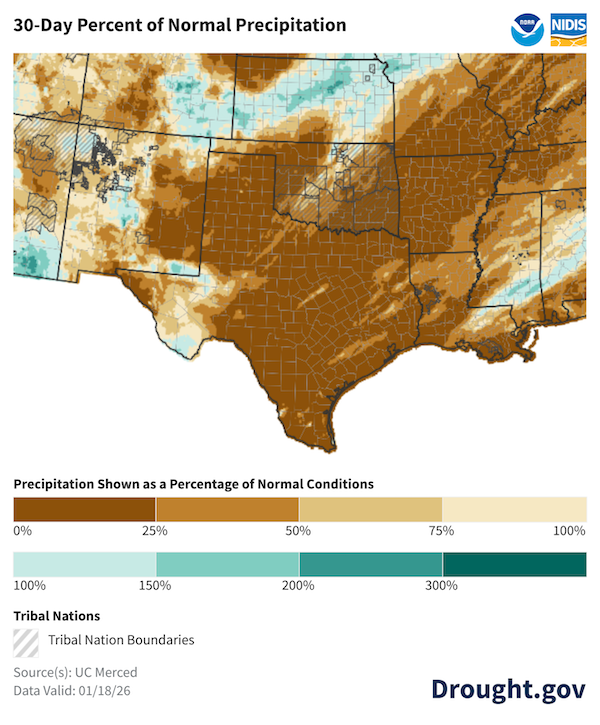
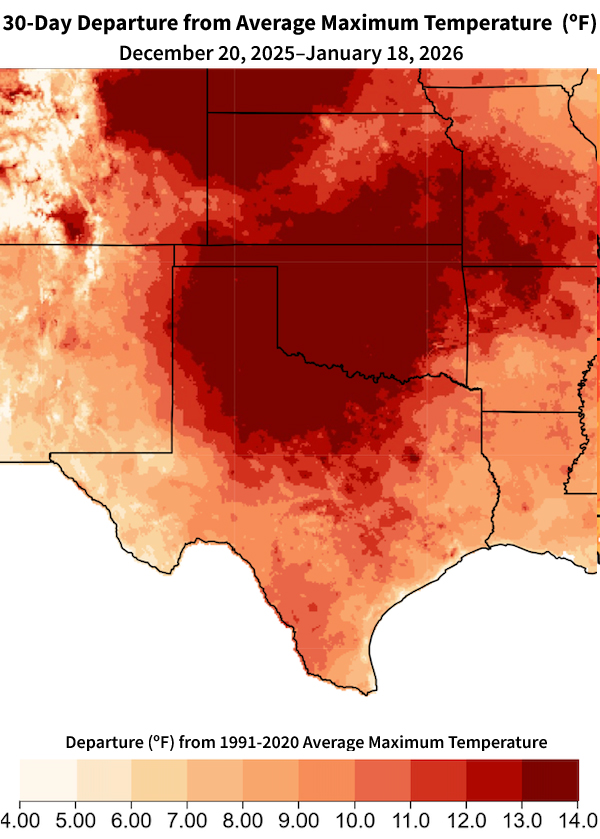
- So far, winter 2025-26 has been exceptionally warm and dry.
- Kansas experienced its 4th driest December on record and tied 1896 as the 4th warmest December on record (since 1895).
- Oklahoma experienced its driest December on record for Oklahoma and tied 1946 and 2015 as the 6th warmest December on record (since 1895).
- Texas experienced its 3rd driest and 3rd warmest December on record (since 1895).
- Texas is currently facing significant drought challenges across multiple regions, affecting rangelands and water supplies and increasing wildfire risks.
- A significant winter storm that is expected this weekend will provide short-term drought relief and break up what has been a persistent warm and dry winter weather pattern.
- However, long-range forecasts suggest that drought in Texas and western Oklahoma will get worse before it gets better. February–April climate outlooks show increased odds of below-normal precipitation and above-normal temperatures for southern and western Texas. With La Niña likely to break down in the early spring, drought conditions should begin to see signs of improvement.
This update is based on data available as of Thursday, January 22, 2026 at 9 a.m. CT. We acknowledge that conditions are evolving.
U.S. Drought Monitor from January 22, 2026. The U.S. Drought Monitor depicts the location and intensity of drought across the country using 5 classifications: Abnormally Dry (D0), showing areas that may be going into or are coming out of drought, and four levels of drought (D1–D4). The U.S. Drought Monitor is a joint effort of the National Drought Mitigation Center, U.S. Department of Agriculture, and National Oceanic and Atmospheric Administration.
A drought index combines multiple drought indicators (e.g., precipitation, temperature, soil moisture) to depict drought conditions. For some products, like the U.S. Drought Monitor, authors combine their analysis of drought indicators with input from local observers. Other drought indices, like the Standardized Precipitation Index (SPI), use an objective calculation to describe the severity, location, timing, and/or duration of drought.
Learn MorePeriods of drought can lead to inadequate water supply, threatening the health, safety, and welfare of communities. Streamflow, groundwater, reservoir, and snowpack data are key to monitoring and forecasting water supply.
Learn MoreDrought can reduce the water availability and water quality necessary for productive farms, ranches, and grazing lands, resulting in significant negative direct and indirect economic impacts to the agricultural sector. Monitoring agricultural drought typically focuses on examining levels of precipitation, evaporative demand, soil moisture, and surface/groundwater quantity and quality.
Learn MoreU.S. Drought Monitor Categories
D0 - Abnormally Dry
Abnormally Dry (D0) indicates a region that is going into or coming out of drought, according to the U.S. Drought Monitor.
D1 – Moderate Drought
Moderate Drought (D1) is the first of four drought categories (D1–D4), according to the U.S. Drought Monitor.
D2 – Severe Drought
Severe Drought (D2) is the second of four drought categories (D1–D4), according to the U.S. Drought Monitor.
D3 – Extreme Drought
Extreme Drought (D3) is the third of four drought categories (D1–D4), according to the U.S. Drought Monitor.
D4 – Exceptional Drought
Exceptional Drought (D4) is the most intense drought category, according to the U.S. Drought Monitor.
Total Area in Drought (D1–D4)
Percent area of the Southern Plains that is currently in drought (D1–D4), according to the U.S. Drought Monitor.
U.S. Drought Monitor from January 22, 2026. The U.S. Drought Monitor depicts the location and intensity of drought across the country using 5 classifications: Abnormally Dry (D0), showing areas that may be going into or are coming out of drought, and four levels of drought (D1–D4). The U.S. Drought Monitor is a joint effort of the National Drought Mitigation Center, U.S. Department of Agriculture, and National Oceanic and Atmospheric Administration.
The U.S. Drought Monitor is updated weekly on Thursday mornings, with data valid through Tuesday at 7 a.m. EST.
A drought index combines multiple drought indicators (e.g., precipitation, temperature, soil moisture) to depict drought conditions. For some products, like the U.S. Drought Monitor, authors combine their analysis of drought indicators with input from local observers. Other drought indices, like the Standardized Precipitation Index (SPI), use an objective calculation to describe the severity, location, timing, and/or duration of drought.
Learn MorePeriods of drought can lead to inadequate water supply, threatening the health, safety, and welfare of communities. Streamflow, groundwater, reservoir, and snowpack data are key to monitoring and forecasting water supply.
Learn MoreDrought can reduce the water availability and water quality necessary for productive farms, ranches, and grazing lands, resulting in significant negative direct and indirect economic impacts to the agricultural sector. Monitoring agricultural drought typically focuses on examining levels of precipitation, evaporative demand, soil moisture, and surface/groundwater quantity and quality.
Learn MoreCurrent Conditions and Impacts for the Southern Plains
- Winter is usually the driest season of the year for the Southern Plains, but so far winter 2025-26 has been exceptionally warm and dry.
- Kansas: 4th driest December on record and tied 1896 as the 4th warmest December on record (since 1895).
- Oklahoma: Driest December on record and tied 1946 and 2015 as the 6th warmest December on record (since 1895).
- Texas: 3rd driest & 3rd warmest December on record (since 1895). The final four months of 2025 were the warmest on record for Texas and the 9th driest on record.
- December precipitation was the lowest on record for the Dallas metro area, Big Country around Abilene, the greater Tulsa area extending into most of northeast Oklahoma, northwest Arkansas, southwest Missouri, and southeast Kansas. View more precipitation rankings from Climate at a Glance and the Southeast Regional Climate Center.
- Texas is currently facing significant drought challenges across multiple regions, affecting water supplies and increasing wildfire risks.
- As of January 21, 2026, combined capacity at Lake Corpus Christi and Choke Canyon Reservoirs fell to 9.7%.
- Extreme Drought (D3) has expanded in parts of central Texas, including the Austin area, according to the U.S. Drought Monitor.
- Big Country (Abilene) went 44 consecutive days without precipitation from November 25, 2025, to January 8, 2026.
- In the Texas Panhandle, low soil moisture has led to pasture and range conditions that range from very poor to good. Winter wheat conditions are reported as being mostly fair. Forecasts show a high likelihood for ample precipitation of up to an inch in some places before the end of January.
- Uptick in wildfire activity: Above-normal grass growth from 2025 and dry conditions have created increased fuel for wildfires.
- Dry conditions have set the stage for higher wildfire potential through early spring 2026, particularly in east Texas.
- In Oklahoma, 12 counties introduced burn bans already this winter.
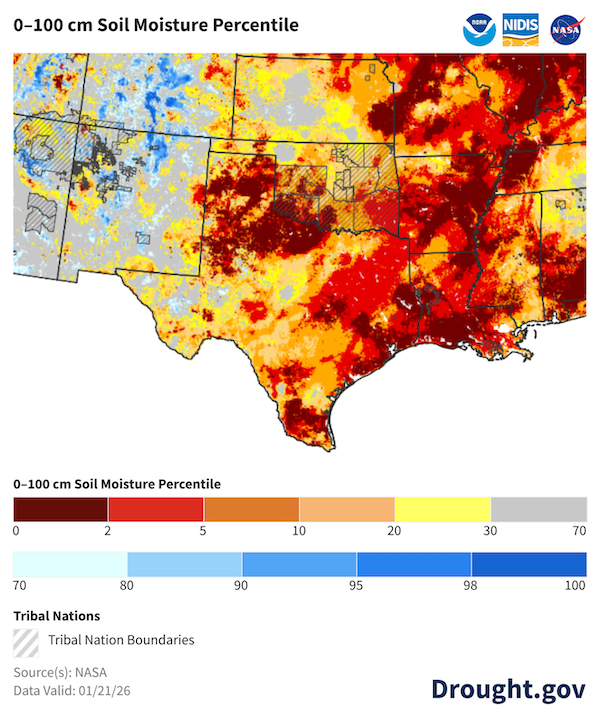
- Soil moisture across Texas, Oklahoma, and eastern Kansas is below the 10th percentile.
- Just outside the Southern Plains Drought Early Warning System region, drought in the Ozarks (Missouri/Arkansas) has led farmers to purchase hay from Kansas to feed livestock.
Mid-December to Mid-January Precipitation Near 0 inches for Texas and Oklahoma
Mid-December to Mid-January Temperatures Were Much Above Average to Record Setting for the Southern Plains
Soil Moisture Across Texas, Oklahoma, and Eastern Kansas is Below the 10th Percentile
Outlooks and Potential Impacts in the Southern Plains
- Significant winter precipitation amounts this week will help reduce developing dryness over western Texas and Oklahoma.
- The National Weather Service Climate Prediction Center’s 8-14 day outlooks favor above-normal precipitation for far southern Texas. Outlooks show mostly below-normal temperatures for the eastern flanks of the Southern Plains.
- February climate outlooks for the Southern Plains mostly show equal chances of above-, near-, or below-normal precipitation and temperatures.
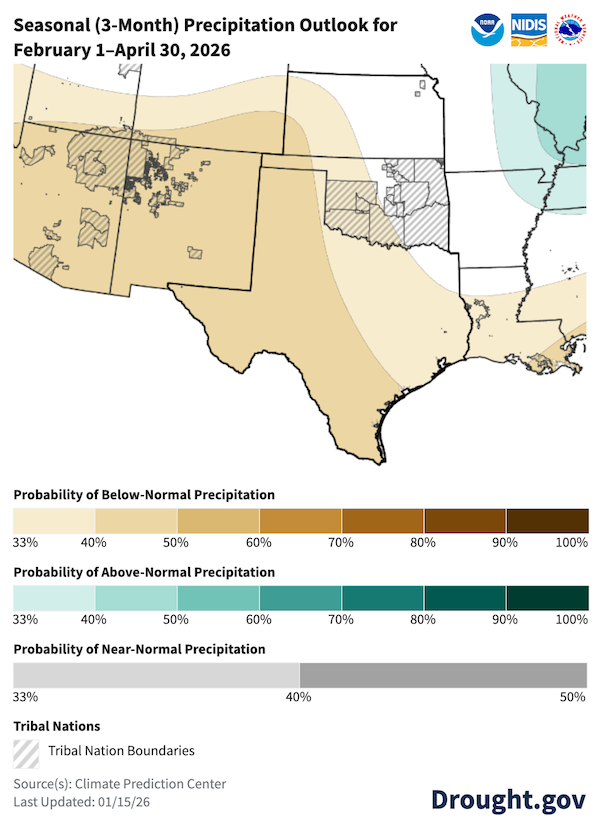
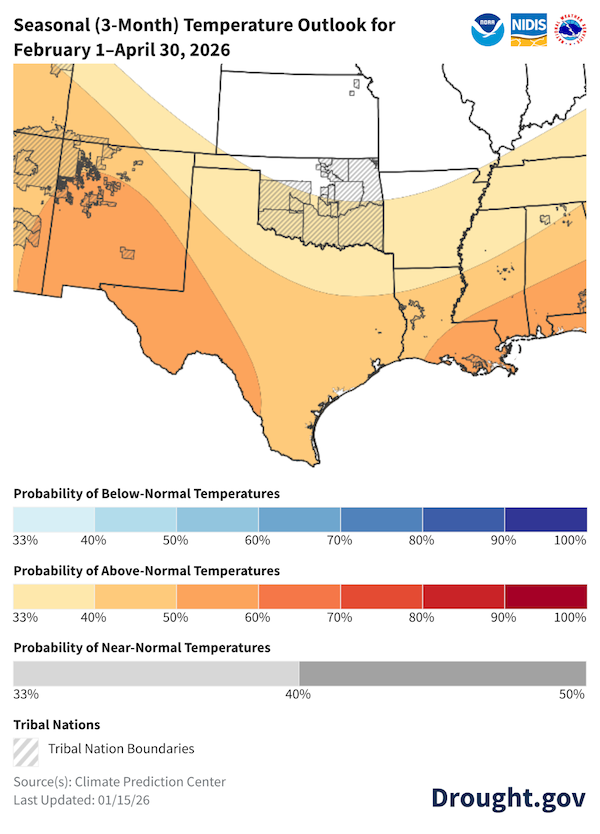
- The February–April outlooks favor a warm and dry season ahead for most of Texas. The strongest odds for below-normal precipitation (40-50% chance) and above-normal temperatures (50-60% chance) are for western Texas and far south Texas and the Oklahoma and Texas panhandles. There are near equal chances for above-, near-, or below-normal temperatures and precipitation across the rest of the region.
- The National Weather Service Climate Prediction Center’s seasonal outlooks and global climate patterns favor drought persistence along the Rio Grande and drought expansion for far western Texas.
- A La Niña Advisory is in place.
- La Niña conditions—which historically increase chances of normal to dry winters in the Southern Plains—are expected to transition to ENSO-neutral during January-March 2026 (75% chance).
- La Niña usually increases chances for a dry winter for most of Texas and southwest Oklahoma, with little impact on the rest of Oklahoma and Kansas.
- An El Niño pattern is possible by late summer or early fall. El Niño usually, but not always, brings wet weather patterns to Texas in winter.
Odds Favor Lower-Than-Normal Precipitation for Most of Southern Texas for February-April
A Warm Start to Spring Is Expected for Texas
Resources
Recent Reports
- Southern Plains Drought Assessment 2020-2025
- Quarterly Climate Impacts and Outlook for the Southern Region - December 2025
Additional Resources by State
- More local information is available from the following resources:
- Your state climatologist
- Your state page on Drought.gov
- National Weather Service Drought Information Statements:
- January 16, 2026: Brownsville, Texas
- January 15, 2026: Lake Charles, Louisiana
- January 12, 2026: Austin/San Antonio, Texas
- January 5, 2026: El Paso, Texas/Santa Teresa, New Mexico
- January 4, 2026: Corpus Christi, Texas
- January 1, 2026: Houston/Galveston, Texas
- More state and regional information is available from the following resources:
- Kansas: Climate and Drought in Kansas; Kansas Water Office; State Climate Office
- Oklahoma: Oklahoma Water Resources Board | Drought Monitoring; Oklahoma Mesonet Drought Tools; State Climate Office
- Texas: Texas Water Development Board | Drought; Texas Commission on Environmental Quality | Drought in Texas; Drought Dashboard: Water Data for Texas; Water Data for Texas | Texas Reservoirs; State Climate Office
- Regional: Southern Regional Climate Center, High Plains Regional Climate Center; Southern Climate Impacts Planning Program (SCIPP)
- To report or view local drought impact information:
Prepared By
Joel Lisonbee
Cooperative Institute for Research in Environmental Sciences/University of Colorado Boulder and NOAA’s National Integrated Drought Information System, Southern Plains Drought Early Warning System
B.J. Baule and John Nielsen-Gammon
Texas State Climate Office, Southern Regional Climate Center, Texas A&M University
Gary McManus
Oklahoma Climatological Survey, State Climatologist
This Drought Status Update is issued in partnership between the National Oceanic and Atmospheric Administration (NOAA) and partners to communicate a potential area of concern for drought expansion and/or development within the Southern Plains Drought Early Warning System region based on recent conditions and the upcoming forecast. NIDIS and its partners will issue future Drought Status Updates as conditions evolve. NIDIS is an interagency program within the Climate Program Office, which is part of NOAA’s Office of Oceanic and Atmospheric Research.