
Research Dataset: Quantifying the Importance of Selected Drought Indicators for the U.S. Drought Monitor by Region and Season
National Aeronautics and Space Administration (NASA) Goddard Space Flight Center Hydrological Sciences Laboratory
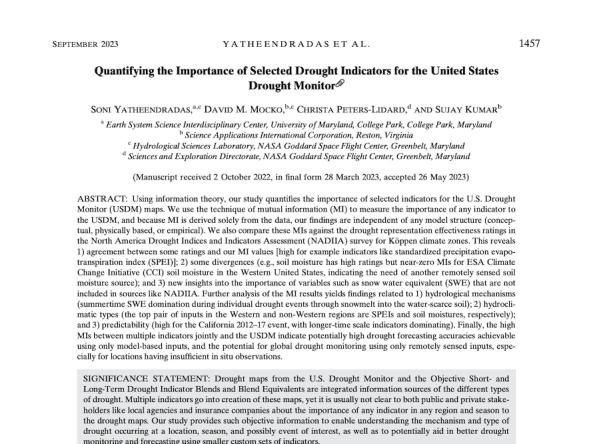
In response to the need to better understand the effectiveness of various drought indicators for different regions and seasons, a team of scientists at the NASA Goddard Space Flight Center conducted research to quantify the relative importance—or “drought explainability”—of specific indicators with respect to the U.S. Drought Monitor (USDM). This research was published in the Journal of Hydrometeorology and was funded by NOAA’s National Integrated Drought Information System (NIDIS).
In the study, the researchers looked at 113 indicators of drought, including in situ (observation-based), modeled, and remote-sensed data across a variety of timescales (from 1 week to 72 months).
The researchers used an information theoretic measure, mutual information, to compare these 113 indicators to U.S. Drought Monitor data from 2006-2019. They broke these results down by geographic region and season (spring, summer, fall, winter, and all seasons). The researchers calculated the mutual information for each of the 113 indicators individually, as well as for several groups of indicators (e.g., all remote-sensing indicators combined). The results show which drought indicators are most representative of the U.S. Drought Monitor’s depiction of drought for a given region and season.
To do this, the research team first spatially interpolated and aggregated all the data to a climate division resolution. They then temporally interpolated and aggregated the indicators to the weekly resolution of the U.S. Drought Monitor maps, and finally calculated historical percentiles for each indicator. They used these percentiles to calculate the indicators’ mutual information with the U.S. Drought Monitor for six regions across the continental U.S., which mostly align with NOAA's Regional Climate Centers: High Plains, Midwest, Northeast, South, Southeast, and West.
This approach looks at information entropy, or the randomness or uncertainty in a given variable. Mutual information is the degree to which one random data stream “explains” another, or the degree of common information between the two streams (e.g., the amount of information obtained about the U.S. Drought Monitor by observing a particular indicator). The researchers then normalized these values, so they could compare results across different locations. The resulting normalized mutual information is called fractional information. The fractional information results are available for download as CSV files below.
Fractional information = Mutual information (of each indicator with the USDM) / USDM information entropy
The researchers additionally calculated the fractional information for NOAA climate divisions (nClimDiv) and at a 1/24 degree (~4.6-km) resolution (nClimGrid). This involved sampling pixel by pixel, including neighboring pixels over a window to facilitate sample size requirements given missing data. These results, which are available as netCDF files below, are experimental and should be used for research purposes only.
The input data used for this analysis are also available, including the data for each indicator and the percentiles for each indicator, calculated at the climate division level.
For more information or for any questions about the data, please contact the research team at the NASA Goddard Space Flight Center.
Access and Documentation
Article in the Journal of Hydrometeorology (regional data at the climate division resolution)
Analyzing Drought Indicator Relevance by Region and Season: Key Takeaways from NASA-Led Research (story map with takeaways nationally and by region)
Explore the Data (interactive table of regional results)
README file (regional, climate division, and 1/24 degree [4.6-km] resolution data)
Download Data
The following NASA research data are available via NOAA's National Centers for Environmental Information (NCEI) and the NOAA Open Data Dissemination program, which promotes reuse of the data and provides public access to data from Google Cloud Storage. Logging in with a Google account is required to use the storage browser.
Within each folder, you will find two subfolders, labeled “All_113Indicators_ValidValues” and “This_Indicator_ValidValues,” with different results. The “All_113Indicators” approach only uses samples with valid values for all 113 indicators included in the study (i.e., it throws out samples where one or more of the 113 indicators does not have data for the period of record). The “This_Indicator” approach includes samples having valid values for the indicator of interest (even if other indicators have missing data).
These experimental data are for research purposes only and should be used with discretion. For additional information or questions about the data, please contact the research team at NASA Goddard Space Flight Center.
- U.S. Drought Monitor Region Scale / Climate Division Resolution (CSV files)
- Climate Division Scale and Resolution (CSV files)
- nClimGrid (1/24 Degree [~4.6-km]) Scale and Resolution (netCDF files)
- Input Data
- ReadMe File (TXT file)