Persistent Drought Continues Across Arkansas, Mississippi, and Louisiana Despite Spring Rainfall Improvements
Key Points
- Drought has been impacting the Lower Mississippi region since August 2025, intensifying over the winter and early spring.
- According to the U.S. Drought Monitor, 99.5% of Arkansas and 93% of Mississippi are currently in Moderate to Exceptional Drought (D1-D4), and 77% of Louisiana is in Moderate to Extreme Drought (D1-D3).
- Drought impacts include poor pasture and rangeland conditions, limited surface pond water for livestock and wildlife, reduced crop production, low streamflows, increased fire risk, and negative impacts to recreational water supply.
- A significant, multi-day storm system is currently providing widespread rainfall to the Lower Mississippi states, with 7 inches forecasted in some locations through May 28.
- This precipitation will provide some relief to drought-affected areas across these three states, but will not end the drought due to the significant precipitation deficits that date back to last summer.
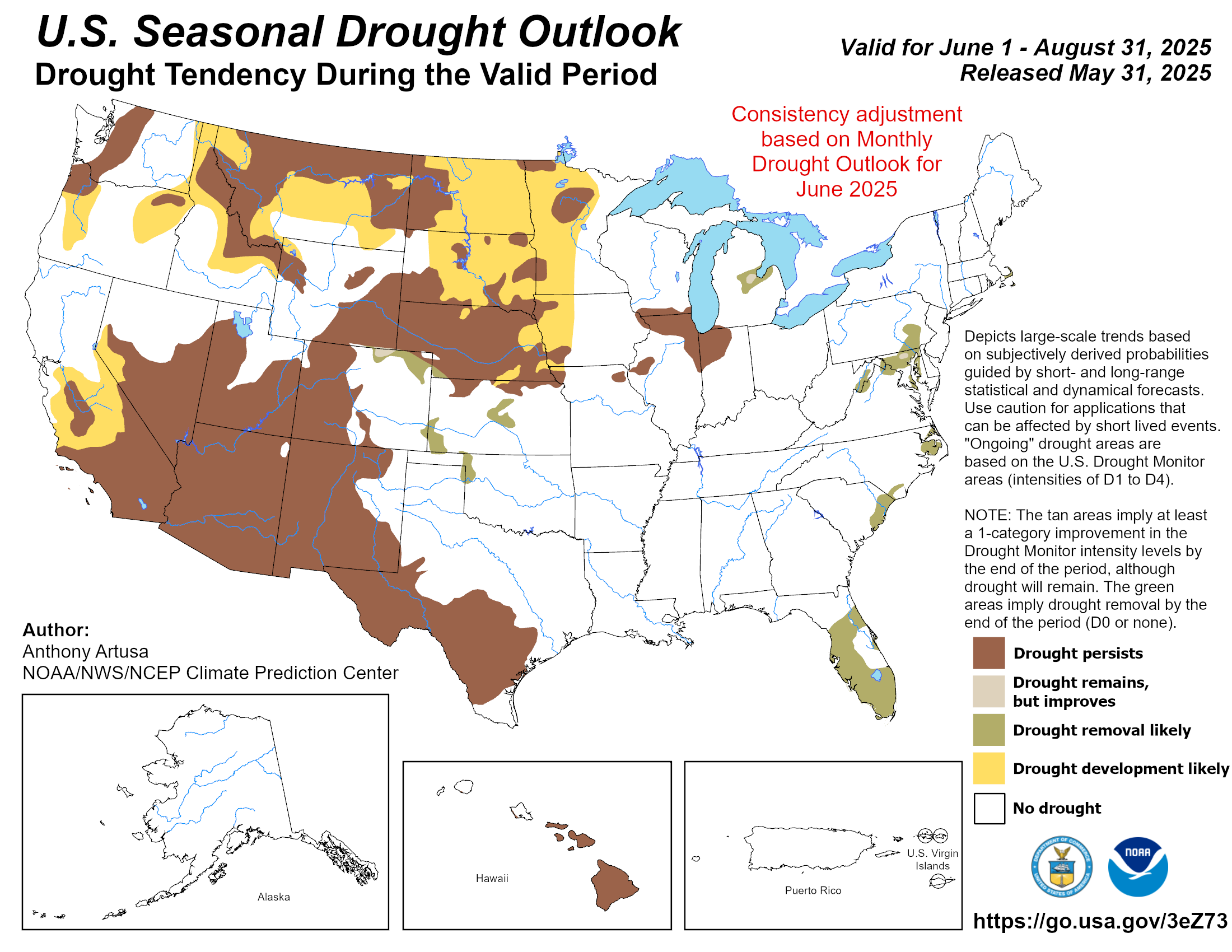
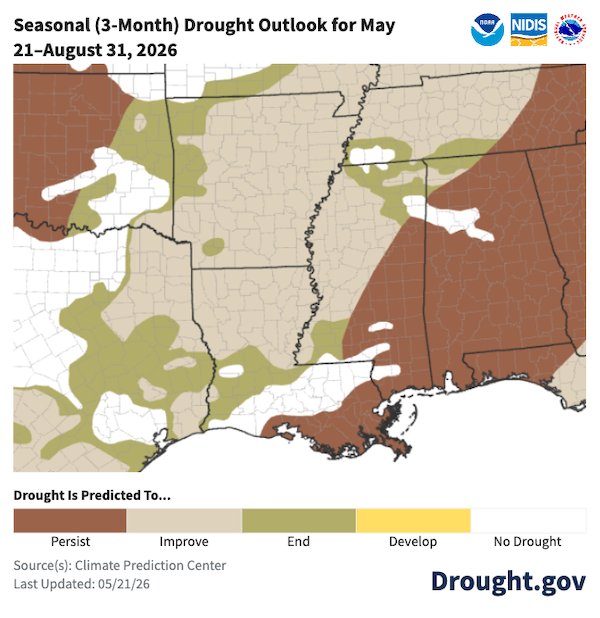
- The seasonal drought outlook for May 21–August 31, 2026 indicates the likelihood that drought conditions will persist in southeastern Louisiana and portions of eastern Mississippi. The outlook is optimistic about drought improvement for most of the region, but not widespread removal of drought in the region.
This update is based on data available as of Thursday, May 21, 2026 at 8:00 a.m. CT. We acknowledge that conditions are evolving.
Current drought conditions in the Lower Mississippi River Basin states, according to the May 19 U.S. Drought Monitor. The U.S. Drought Monitor depicts the location and intensity of drought across the country using 5 classifications: Abnormally Dry (D0), showing areas that may be going into or are coming out of drought, and four levels of drought (D1–D4).
The U.S. Drought Monitor is a joint effort of the National Drought Mitigation Center, U.S. Department of Agriculture, National Oceanic and Atmospheric Administration, and National Aeronautics and Space Administration.
A drought index combines multiple drought indicators (e.g., precipitation, temperature, soil moisture) to depict drought conditions. For some products, like the U.S. Drought Monitor, authors combine their analysis of drought indicators with input from local observers. Other drought indices, like the Standardized Precipitation Index (SPI), use an objective calculation to describe the severity, location, timing, and/or duration of drought.
Learn MorePeriods of drought can lead to inadequate water supply, threatening the health, safety, and welfare of communities. Streamflow, groundwater, reservoir, and snowpack data are key to monitoring and forecasting water supply.
Learn MoreDrought can reduce the water availability and water quality necessary for productive farms, ranches, and grazing lands, resulting in significant negative direct and indirect economic impacts to the agricultural sector. Monitoring agricultural drought typically focuses on examining levels of precipitation, evaporative demand, soil moisture, and surface/groundwater quantity and quality.
Learn MoreU.S. Drought Monitor Categories: Lower Mississippi States
D0 - Abnormally Dry
Abnormally Dry (D0) indicates a region that is going into or coming out of drought, according to the U.S. Drought Monitor.
D1 – Moderate Drought
Moderate Drought (D1) is the first of four drought categories (D1–D4), according to the U.S. Drought Monitor.
D2 – Severe Drought
Severe Drought (D2) is the second of four drought categories (D1–D4), according to the U.S. Drought Monitor.
D3 – Extreme Drought
Extreme Drought (D3) is the third of four drought categories (D1–D4), according to the U.S. Drought Monitor.
D4 – Exceptional Drought
Exceptional Drought (D4) is the most intense drought category, according to the U.S. Drought Monitor.
Total Area in Drought (D1–D4)
Percent area of the Lower Mississippi states (Arkansas, Louisiana, and Mississippi) currently in drought (D1–D4), according to the U.S. Drought Monitor.
Current drought conditions in the Lower Mississippi River Basin states, according to the May 19 U.S. Drought Monitor. The U.S. Drought Monitor depicts the location and intensity of drought across the country using 5 classifications: Abnormally Dry (D0), showing areas that may be going into or are coming out of drought, and four levels of drought (D1–D4).
The U.S. Drought Monitor is a joint effort of the National Drought Mitigation Center, U.S. Department of Agriculture, National Oceanic and Atmospheric Administration, and National Aeronautics and Space Administration.
The U.S. Drought Monitor is updated weekly on Thursday mornings, with data valid through the previous Tuesday morning.
A drought index combines multiple drought indicators (e.g., precipitation, temperature, soil moisture) to depict drought conditions. For some products, like the U.S. Drought Monitor, authors combine their analysis of drought indicators with input from local observers. Other drought indices, like the Standardized Precipitation Index (SPI), use an objective calculation to describe the severity, location, timing, and/or duration of drought.
Learn MorePeriods of drought can lead to inadequate water supply, threatening the health, safety, and welfare of communities. Streamflow, groundwater, reservoir, and snowpack data are key to monitoring and forecasting water supply.
Learn MoreDrought can reduce the water availability and water quality necessary for productive farms, ranches, and grazing lands, resulting in significant negative direct and indirect economic impacts to the agricultural sector. Monitoring agricultural drought typically focuses on examining levels of precipitation, evaporative demand, soil moisture, and surface/groundwater quantity and quality.
Learn MoreCurrent Conditions and Impacts for the Lower Mississippi States
- In the nine months from August 2025 (when the drought started) through April 2026, Lower Mississippi states have seen over a foot less rain than expected:
- Arkansas total precipitation is 13.7 inches below average
- Mississippi total is 12.7 inches below average
- Louisiana total is 13.3 inches below average
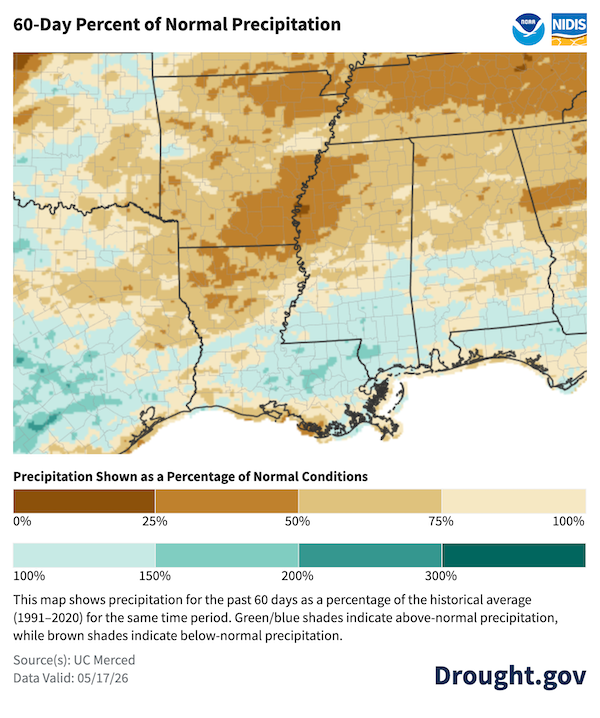
- Precipitation has been below normal over the last 60 days across central and eastern Arkansas, northern Mississippi, and northern Louisiana. Pockets along the Louisiana coast also show significant precipitation deficits.
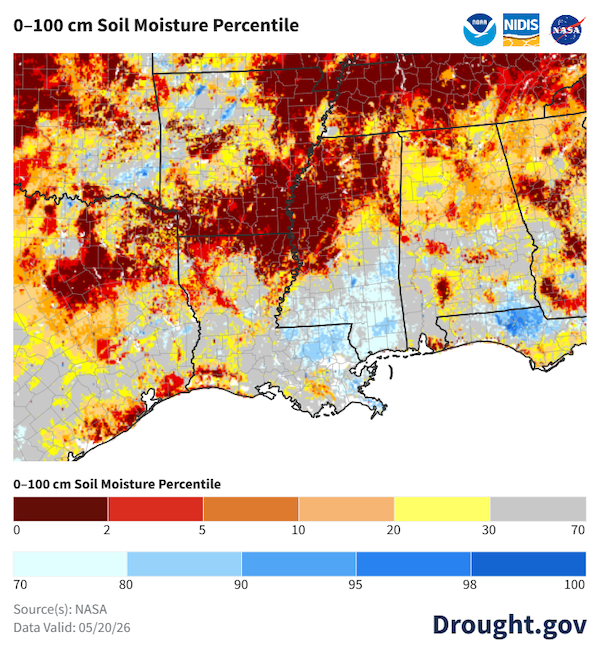
- A large region of exceptionally low soil moisture (below the 2nd percentile) is centered over the Mississippi River Valley, covering most of Arkansas and extending into northern Mississippi.
- On-the-ground drought reports through the Condition Monitoring Observer Reports (CMOR) system indicate very poor pasture and range conditions, including limited to no surface pond water, for cattle producers in all three Lower Mississippi states.
- Media reports describe dying crops due to a lack of spring rain and increased wildfires.
60-Day Precipitation Below 50% of Normal for Arkansas, Northern Mississippi, and Northern Louisiana
Below-Normal Soil Moisture Across Arkansas, Northern Mississippi, and Northern Louisiana
Outlooks and Potential Impacts for the Lower Mississippi States
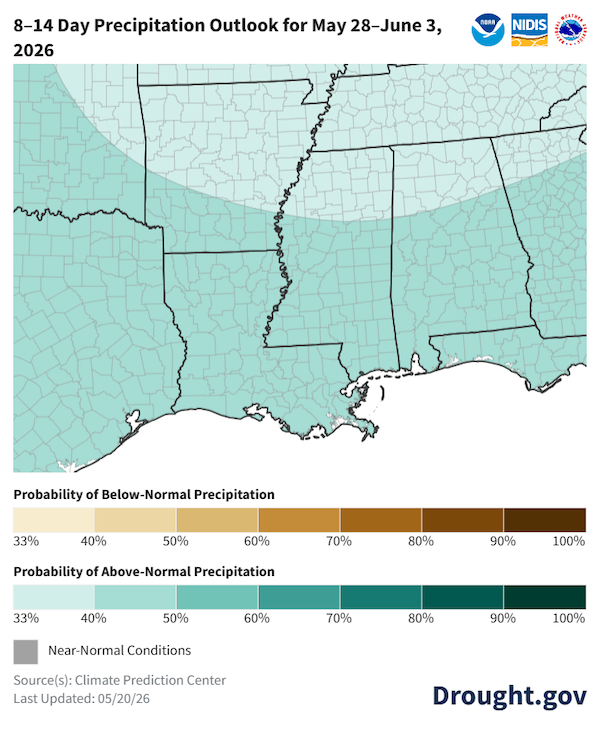
- The National Weather Service Climate Prediction Center’s 6-10 and 8-14 day outlooks favor warm and wet weather across the Lower Mississippi states, indicating a pattern shift compared to March and April. This could bring short-term drought improvement, but precipitation deficits in the region date back to last summer.
- The June to August precipitation outlook shows an equal chance of above-, near-, or below-normal precipitation for the Lower Mississippi states, except the southwest portion of Louisiana, which has a 33-40% chance of below-normal precipitation. A warm summer is likely (33-50% chance) for all of the Lower Mississippi states, particularly for southern Arkansas, southern Mississippi, and Louisiana.
- While the Climate Prediction Center’s seasonal (3-month) drought outlook predicts widespread improvement, drought is forecast to remain in much of the region through August.
- An El Niño Watch is in place.
- El Niño has the strongest influence during the winter months, but can occasionally drive summer weather.
- El Niño conditions have a variable impact on Lower Mississippi weather patterns depending on the time of the year. Historically, there is not a dominant summertime weather pattern during developing El Niños.
Wet Weather in Late May and Early June Should Bring Continued Short-Term Drought Improvement
Drought Improvement or Removal Likely by End of August Across Majority of Lower Mississippi States
Additional Resources
Recent News and Reports
- New NOAA El Niño-Southern Oscillation Index Supports Drought Early Warning
- El Niño on the Horizon: Can the Warm Phase End Six Years of Drought in the Southern Plains of the U.S.?
- Quarterly Climate Impacts and Outlook for the Southern Region - March 2026
Additional Resources by State
More local information is available from the following resources:
- Your state page on Drought.gov:
- Sign up for Lower Mississippi River Basin emails from NIDIS
- National Weather Service Drought Information Statements:
- May 7, 2026: Little Rock, Arkansas
- May 7, 2026: Jackson, Mississippi
- May 7, 2026: Lake Charles, Louisiana
- April 30, 2026: New Orleans, Louisiana
- April 30, 2026: Memphis, Tennessee
- March 19, 2026: Shreveport, Louisiana
- To report or view local drought impact information:
Prepared By
Joel Lisonbee, Molly Woloszyn
Cooperative Institute for Research in Environmental Sciences/University of Colorado Boulder and NOAA’s National Integrated Drought Information System
Elliot Wickham
Cooperative Institute for Research to Operational Hydrology/University of Alabama and NOAA’s National Integrated Drought Information System
John Nielson-Gammon
Southern Regional Climate Center, Texas A&M University
Kyle Brehe
Louisiana Office of State Climatology, Louisiana State University
Chris Buonanno
NOAA National Weather Service Little Rock Weather Forecast Office
Julie Lesko
NOAA National Weather Service New Orleans Weather Forecast Office
This Drought Status Update is issued in partnership between the National Oceanic and Atmospheric Administration (NOAA) and partners to communicate a potential area of concern for drought expansion and/or development within Arkansas, Louisiana, and Mississippi based on recent conditions and the upcoming forecast. NIDIS and its partners will issue future Drought Status Updates as conditions evolve. NIDIS is an interagency program within the Climate Program Office, which is part of NOAA’s Office of Oceanic and Atmospheric Research.