
New TroutCast Tool Brings Drought Forecasting to Montana’s Blue-Ribbon Trout Rivers
A new interactive web-based tool, TroutCast, launched on June 1, 2026 to help forecast drought impacts on trout populations and support fisheries and water management across Montana’s renowned blue-ribbon rivers.
Funded by the National Oceanic and Atmospheric Administration National Integrated Drought Information System (NOAA-NIDIS) and developed through a partnership among the U.S. Geological Survey (USGS), Montana State University, and Montana Fish, Wildlife & Parks (MFWP), TroutCast provides seasonal and long-term forecasts to inform proactive decision-making for fisheries management, drought response, and recreational angling opportunities. In 2024-2025, fishing activity generated $1.5 billion for Montana businesses.
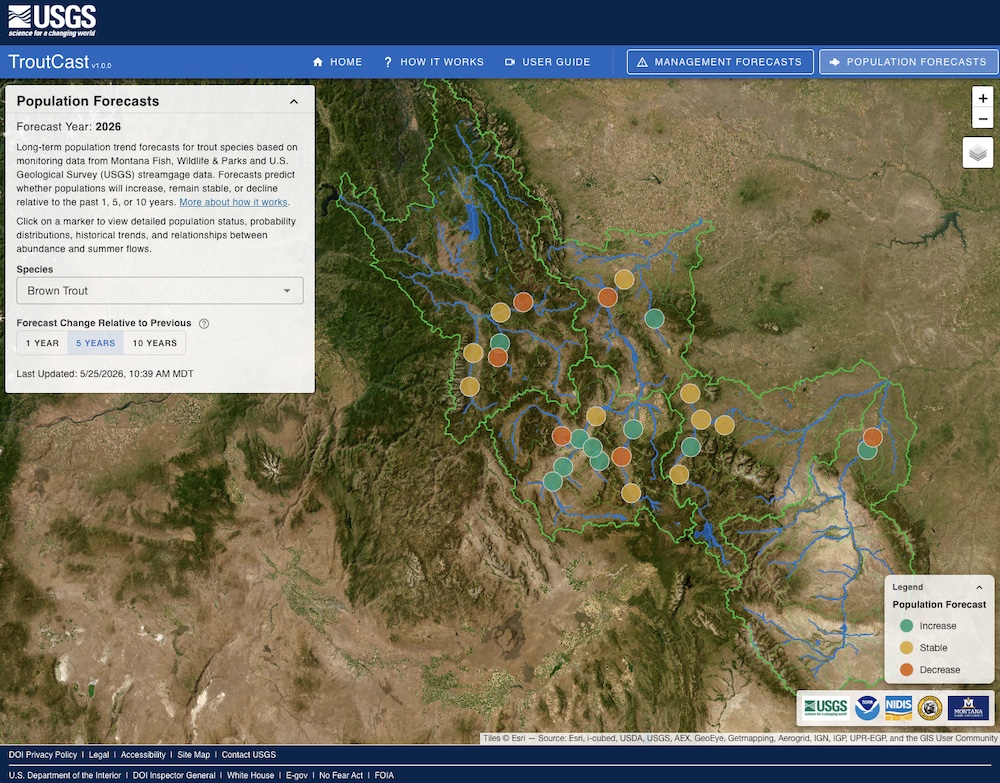
TroutCast integrates long-term trout population monitoring data from MFWP, USGS streamflow records, and weather information to generate management (1–4 week) and long-term (1–3 year) forecasts of trout population trends and drought risk. The tool also estimates the likelihood of fisheries management actions triggered by drought-related low streamflows or elevated water temperatures.
“TroutCast is a game-changer for drought preparedness, directly connecting our early warning capabilities to the well-being of Montana's critical fishing industry,” said Veva Deheza, NIDIS Executive Director. “By forecasting specific impacts on trout, we’re empowering managers and stakeholders to take steps weeks or months ahead of a severe drought.”
“TroutCast brings together decades of fisheries monitoring and streamflow records into a practical tool that managers and the public can use in real time,” said Timothy Cline of Montana State University. “It reflects a growing scientific understanding that river flow is a primary driver of trout production in rivers, with abundance increasing during wetter periods and declining during droughts.”
For the first time, the team has quantified how specific streamflow levels translate into trout production and trout abundance in Montana’s iconic rivers. TroutCast uses these relationships to support water planning and management by linking hydrologic conditions directly to ecological outcomes. Even a small difference in the amount of water carried by a stream can affect trout populations dramatically, said Cline, and users will be able to use a slider function on TroutCast’s population tool to see the correlation. He cited as an example the Ruby River, which supports 384 fish per mile at a streamflow rate of 140 cubic feet per second (cfs). If the streamflow increases in the Ruby by 20 cfs, the population of fish per square mile may nearly double to 784. “That’s what we really hope this tool gets used for,” Cline said.
Increasing drought frequency and severity across the West have placed growing stress on cold-water fisheries by reducing streamflows, elevating water temperatures, and contributing to trout population declines. These changes have important ecological and economic implications for communities that rely on recreational fishing, outfitting, and tourism.
“Cold-water fisheries across the West are increasingly vulnerable to drought, putting both trout populations and angling opportunities at greater risk” said Clint Muhlfeld of the USGS Northern Rocky Mountain Science Center. “TroutCast links streamflow and temperature conditions with trout population responses, enabling proactive, science-based decision-making that supports sustainable fisheries, recreational opportunities, and the long-term resilience of freshwater resources in the face of drought and changing river flows”.
Beyond fisheries conservation, the tool is expected to benefit local and regional economies by helping sustain recreational fishing opportunities and improving predictability around drought-related management decisions. USGS research indicates that anglers are already adapting to drought conditions by shifting fishing locations within Montana, helping sustain economic activity, though long-term pressures are expected to increase demand for proactive decision-support tools like TroutCast.
"This tool revolutionizes the state’s ability to communicate trends in fish populations, manage angling opportunities, and inform instream flows,” said David Schmetterling, Fisheries Research Coordinator for Montana Fish, Wildlife & Parks. “TroutCast predictions allow us to be proactive by providing information for anglers, outfitters, and fishery managers to make decisions by better understanding how drought and streamflow affect these socially and economically important fisheries."
The initial rollout focuses on Montana’s rivers, with planned expansion to the upper Snake River basin in Idaho and Wyoming, followed by broader application across additional drought-affected western states.
TroutCast was developed through a multi-agency effort initiated in 2022 and supports Montana’s Drought Management Plan, the USGS Integrated Drought Science Strategy, and NOAA-NIDIS by improving drought early warning and providing actionable scientific information for natural resource management.