
For Flash Drought, Timing Matters
Flash drought can develop quickly, sometimes transforming relatively normal conditions into significant drought in just a few weeks. That rapid development makes flash drought detection particularly challenging in the Southeastern United States, where frequent rainfall can be followed by short periods of intense heat and little precipitation.
That challenge is especially evident during the growing season, when rapid drying can have immediate consequences. In the Southeast, the question is not only whether flash drought is developing, but also when it is developing and what is vulnerable at that time.
A new NIDIS-funded study published in the Journal of Applied Meteorology and Climatology examined flash drought risk across the Southeast from 2001–2023 and how the timing of these events overlaps with periods when major crops are most sensitive to water stress.
Researchers from the University of Alabama in Huntsville compared four approaches for identifying flash drought: the Soil Moisture Volatility Index (SMVI), Evaporative Stress Index (ESI), Lawn and Garden Moisture Index (LGI), and rapid changes in the U.S. Drought Monitor. Although the methods differed in how frequently they identified flash drought, they showed several common patterns. Flash drought occurred somewhere in the Southeast every year during the study period, and events were most common in early summer and again in the fall.
When Drought Happens Can Be Just as Important as How Severe It Is
For agriculture, drought impacts depend not only on how much rain falls but also on when that rain falls and how long any dry spells last. Crops have specific stages of development when adequate moisture is particularly important. For example, the moisture-sensitive growth stage for corn typically occurs in late June. Water stress during flowering, pollination, or grain development can have a much greater effect than the same conditions occurring earlier or later in the season.
To account for this vulnerability, researchers developed spatial crop calendars for corn, soybean, cotton, and peanut and compared the timing of critical crop-development periods with more than two decades of flash drought observations.
The results showed that agricultural exposure to flash drought varies considerably across the Southeast. Corn had the greatest overall exposure, followed closely by soybean. In some locations, a substantial portion of historical flash droughts occurred during critical periods of crop development. For corn, about one in five flash droughts occurred during its most moisture-sensitive growth stage, on average, with that proportion exceeding one in two in some locations. Corn and soybean showed particularly high exposure in parts of the lower Mississippi Valley, central Georgia, and eastern North Carolina.
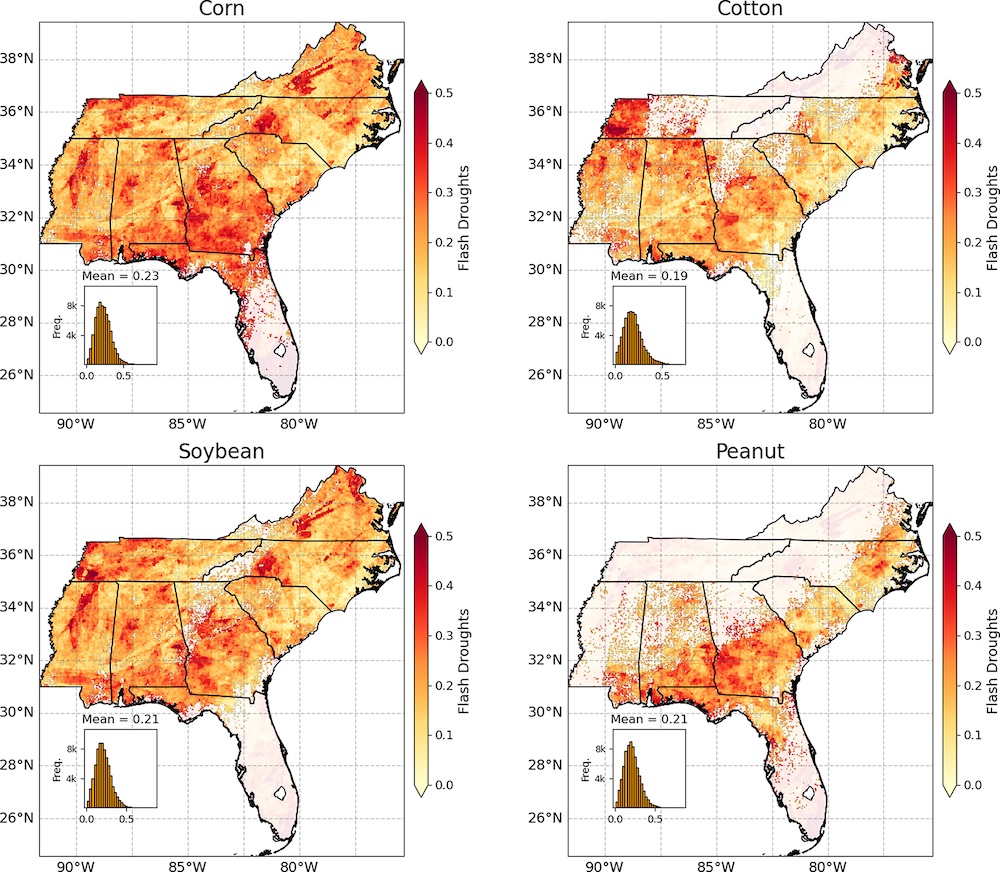
These results also highlight a limitation of looking only at seasonal rainfall totals when monitoring drought. A growing season can receive near-normal rainfall overall while still experiencing a short, rapidly developing drought at exactly the wrong time for a crop.
This makes timing an important component of flash drought early warning. Combining information about how quickly conditions are changing with information on when crops and other drought-sensitive sectors are most vulnerable could help drought monitoring move beyond simply identifying drought. It could also help us anticipate when rapidly changing conditions are most likely to have real-world consequences.