
U.S. flag

An official website of the United States government

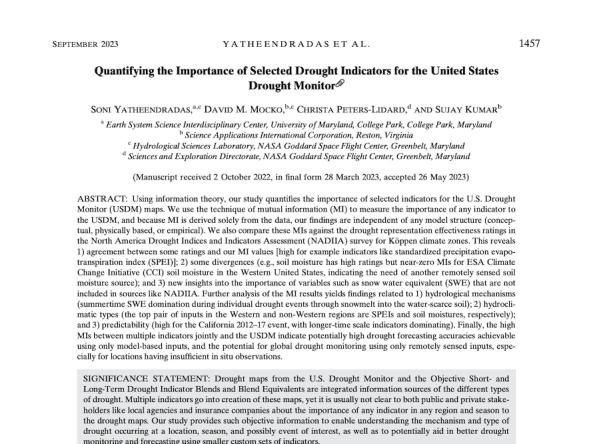
A team of scientists at the NASA Goddard Space Flight Center conducted research to quantify the relative importance—or “drought explainability”—of specific indicators with respect to the U.S. Drought Monitor.

Published on

NOAA's National Integrated Drought Information System (NIDIS), in partnership with the Southern Regional Climate Center (SRCC), conducted a post-drought assessment of the Southern Plains drought of 2020-2025 to understand the drought’s evolution and impacts (including economic costs) and communicate them to decision-makers across the region, the private sector, and the public. 

Published on

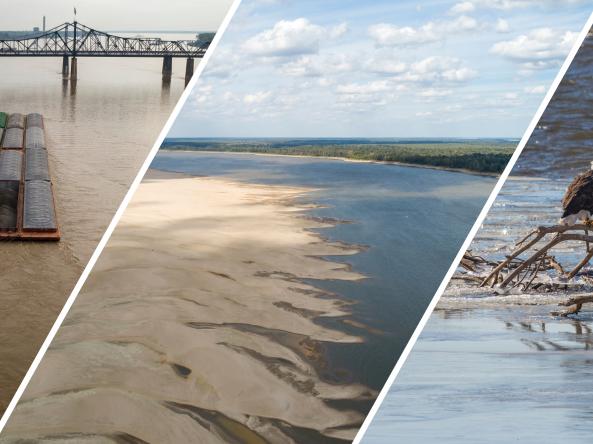
Actionable, user-friendly, and reliable information is essential for risk-informed decision-making across the Mississippi River Basin. In response to impacts of drought in the region, NOAA’s National Integrated Drought Information System (NIDIS) built a Mississippi River Basin Drought and Water Dashboard

Published on

NOAA’s National Integrated Drought Information System (NIDIS) has awarded $1.95 million in funding for projects to support tribal drought resilience as part of President Biden’s Investing in America agenda. This investment will help tribal nations address current and future drought risk on tribal lands across the Western U.S. while informing decision-making and strengthening tribal drought resilience in a changing climate. 

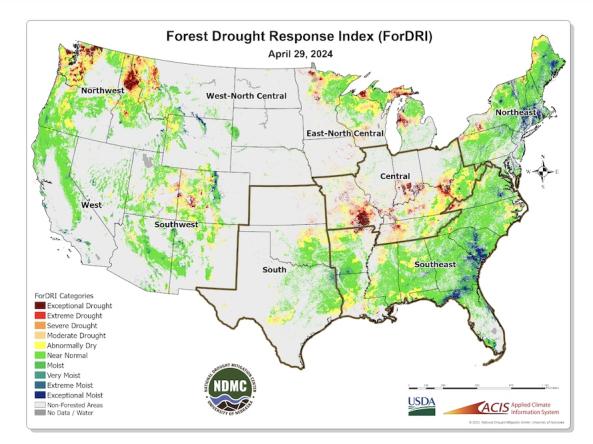
The Forest Drought Response Index (ForDRI) is a new combined indicator tool to identify and characterize forest drought stress. The ForDRI presents a weekly depiction of drought-related forest stress across the continental U.S. 

Published on

Created through a partnership between researchers at the Desert Research Institute, the University of California Merced, Google, NOAA’s National Integrated Drought Information System (NIDIS), and other federal partners, Climate Engine allows users to create maps and time series plots for visualizing complex climate data. Now, the team is launching a new publicly accessible platform designed to produce easy to understand,  detailed reports for every Bureau of Land Management state office, district office, field office, and grazing allotment in the contiguous United States.

Event Date
October 11, 2022
1:00 pm - 1:35 pm
Location
Virtual

The Southwest is in continuing drought. This webinar looked at current and forecast drought conditions for Arizona, Colorado, New Mexico, Nevada, and Utah.

Event Date
September 13, 2022
1:00 pm - 1:35 pm
Location
Virtual

The Southwest is in continuing drought. Recent summer rains have improved but not removed drought from the Southwest. This webinar looked at current and forecast drought conditions for Arizona, Colorado, New Mexico, Nevada, and Utah. Despite a wet summer, the Great Salt Lake has hit a historic, all-time low water level; this webinar also looked at the recently released Great Salt Lake Hydro Mapper tool developed by USGS and State of Utah.

Event Date
August 9, 2022
12:00 pm - 12:35 pm
Location
Virtual

The Southwest is in continuing drought. This short drought briefing looked at how recent monsoon rain has changed drought conditions for Arizona, Colorado, New Mexico, Nevada, and Utah. This webinar also took a closer look at drought monitoring using data and tools from the USDA Agricultural Research Service in partnership with the PhenoCam Network.

Published on

Increases in atmospheric water demand results in more water being drawn from the land surface into the atmosphere through evaporation and transpiration from plants, which can limit the amount of water available to humans and ecosystems, especially in arid regions where less water is available in the first place. Rsearchers from the Desert Research Institute, with funding from NIDIS, conducted a study to answer three questions: (1) how much has evaporative demand changed across the continental U.S., (2) how consistent are the observed changes among different commonly used datasets, and (3) what climate variables are predominantly driving this change? To do this, they quantified reference evapotranspiration (ETo), which is a standardized measure of evaporative demand that would occur across an idealized and specific well-watered ‘reference’ surface composed of short grass. 

Subscribe to Vegetation