Drought and Fires Impact Southern Plains, But March Precipitation Could Bring Short-Term Relief
Key Points
- Fires have burned across Oklahoma, southwest Kansas, and the Texas Panhandle this winter.
- Texas and Oklahoma are currently facing significant drought challenges across multiple regions, affecting rangelands and water supplies and increasing wildfire risk.
- Recent rain in central Kansas improved conditions, but Abnormally Dry (D0) to Severe Drought (D2) conditions persist along the Kansas/Oklahoma border.
- Long-range forecasts suggest that temperatures are likely to remain above normal, but drought in Texas and western Oklahoma will begin to see some short-term improvement.
- Sub-seasonal outlooks show a warm and wet pattern for the Southern Plains in early March.
- With La Niña likely to break down in early spring, drought conditions should begin to see signs of improvement.
This update is based on data available as of Thursday, February 26, 2026 at 9 a.m. CT. We acknowledge that conditions are evolving.
U.S. Drought Monitor from February 24, 2026. The U.S. Drought Monitor depicts the location and intensity of drought across the country using 5 classifications: Abnormally Dry (D0), showing areas that may be going into or are coming out of drought, and four levels of drought (D1–D4). The U.S. Drought Monitor is a joint effort of the National Drought Mitigation Center, U.S. Department of Agriculture, National Oceanic and Atmospheric Administration, and National Aeronautics and Space Administration.
A drought index combines multiple drought indicators (e.g., precipitation, temperature, soil moisture) to depict drought conditions. For some products, like the U.S. Drought Monitor, authors combine their analysis of drought indicators with input from local observers. Other drought indices, like the Standardized Precipitation Index (SPI), use an objective calculation to describe the severity, location, timing, and/or duration of drought.
Learn MorePeriods of drought can lead to inadequate water supply, threatening the health, safety, and welfare of communities. Streamflow, groundwater, reservoir, and snowpack data are key to monitoring and forecasting water supply.
Learn MoreDrought can reduce the water availability and water quality necessary for productive farms, ranches, and grazing lands, resulting in significant negative direct and indirect economic impacts to the agricultural sector. Monitoring agricultural drought typically focuses on examining levels of precipitation, evaporative demand, soil moisture, and surface/groundwater quantity and quality.
Learn MoreU.S. Drought Monitor Categories
D0 - Abnormally Dry
Abnormally Dry (D0) indicates a region that is going into or coming out of drought, according to the U.S. Drought Monitor.
D1 – Moderate Drought
Moderate Drought (D1) is the first of four drought categories (D1–D4), according to the U.S. Drought Monitor.
D2 – Severe Drought
Severe Drought (D2) is the second of four drought categories (D1–D4), according to the U.S. Drought Monitor.
D3 – Extreme Drought
Extreme Drought (D3) is the third of four drought categories (D1–D4), according to the U.S. Drought Monitor.
D4 – Exceptional Drought
Exceptional Drought (D4) is the most intense drought category, according to the U.S. Drought Monitor.
Total Area in Drought (D1–D4)
Percent area of the Southern Plains that is currently in drought (D1–D4), according to the U.S. Drought Monitor.
U.S. Drought Monitor from February 24, 2026. The U.S. Drought Monitor depicts the location and intensity of drought across the country using 5 classifications: Abnormally Dry (D0), showing areas that may be going into or are coming out of drought, and four levels of drought (D1–D4). The U.S. Drought Monitor is a joint effort of the National Drought Mitigation Center, U.S. Department of Agriculture, National Oceanic and Atmospheric Administration, and National Aeronautics and Space Administration.
The U.S. Drought Monitor is updated weekly on Thursday mornings, with data valid through Tuesday at 7 a.m. EST.
A drought index combines multiple drought indicators (e.g., precipitation, temperature, soil moisture) to depict drought conditions. For some products, like the U.S. Drought Monitor, authors combine their analysis of drought indicators with input from local observers. Other drought indices, like the Standardized Precipitation Index (SPI), use an objective calculation to describe the severity, location, timing, and/or duration of drought.
Learn MorePeriods of drought can lead to inadequate water supply, threatening the health, safety, and welfare of communities. Streamflow, groundwater, reservoir, and snowpack data are key to monitoring and forecasting water supply.
Learn MoreDrought can reduce the water availability and water quality necessary for productive farms, ranches, and grazing lands, resulting in significant negative direct and indirect economic impacts to the agricultural sector. Monitoring agricultural drought typically focuses on examining levels of precipitation, evaporative demand, soil moisture, and surface/groundwater quantity and quality.
Learn MoreCurrent Conditions and Impacts for the Southern Plains
- February is typically one of the driest months across the Southern Plains. It is the driest month of the year for Texas and second driest for Kansas and Oklahoma, on average.
- Texas and Oklahoma are currently facing significant drought challenges across multiple regions, affecting water supplies and increasing wildfire risk.
- Severe to Extreme (D2-D3) drought across central and eastern Oklahoma has prompted a series of county-wide burn bans, including in Tulsa County.
- Exceptional Drought (D4) continued in Big Bend National Park, and returned to far southern Texas. Extreme Drought (D3) expanded again across parts of central Texas, including Austin and San Antonio and an area north of Houston, according to the U.S. Drought Monitor.
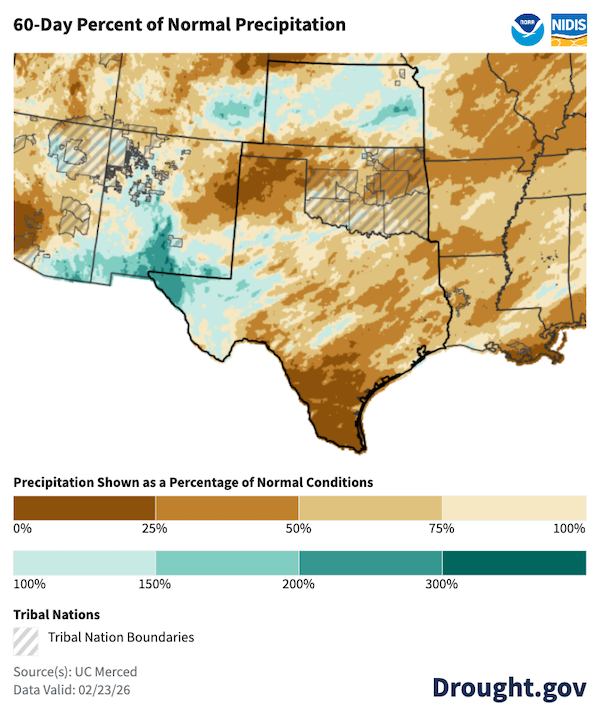
- While the late January winter storm provided temporary relief to parched topsoil in the Panhandle and South Plains region of Texas, the underlying drought remains critical. The February 18 Texas A&M AgriLife report describes long-term drought taking a toll in the South and Coastal Bend regions of Texas, which has had little to no precipitation and a few hard freezes this winter. This damaged fruit and vegetable crops and forced producers to purchase supplemental feed, haul water, and continue deeper culls to their herds.
- Combined capacity at Lake Corpus Christi and Choke Canyon Reservoirs fell to 9.3%. Along the Rio Grande, Elephant Butte reservoir is at 11.8%, Amistad is at 32.9%, and Falcon is at 20.6% of capacity.
- Of the three states in the Southern Plains, Kansas has the least drought so far this winter. Parts of central and eastern Kansas received rainfall in excess of 4 inches in late February. However, Moderate to Severe Drought (D1 to D2) is present in the southeast, with Abnormally Dry (D0) to Moderate Drought (D1) conditions in the southwest where wildland fires spread rapidly in late February.
- While final numbers are not in yet, large parts of the region, including Kansas and the Oklahoma and Texas Panhandles, are likely to see both winter and February rank within the top five warmest compared to historical records.
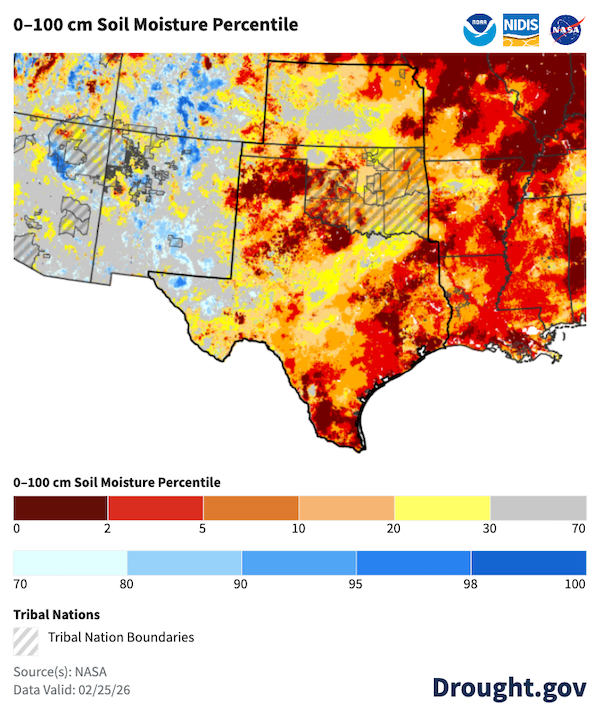
- Soil moisture across most of Texas, Oklahoma, and eastern Kansas is below the 10th percentile.
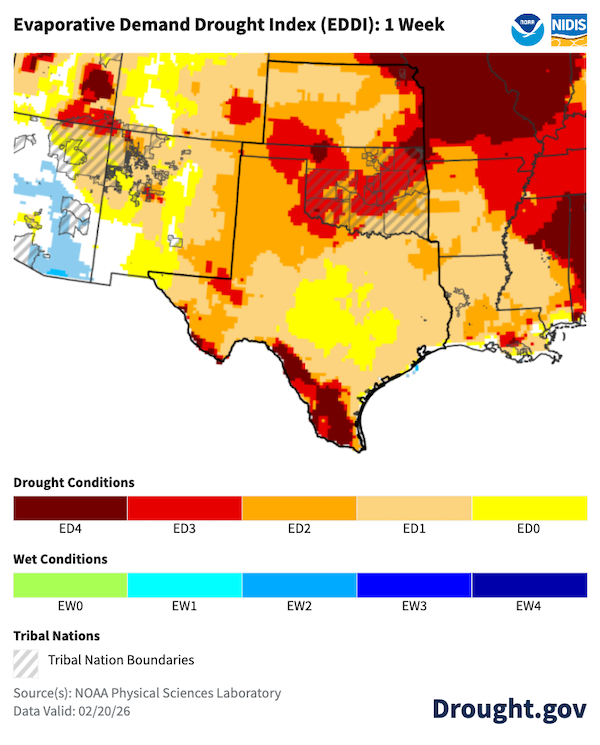
- The Evaporative Demand Drought Index (EDDI) spiked in mid-February over southwest Kansas and the Oklahoma and Texas Panhandles. This indicated rapid drying of the landscape in the week prior to and during the spread of very large fires in these areas.
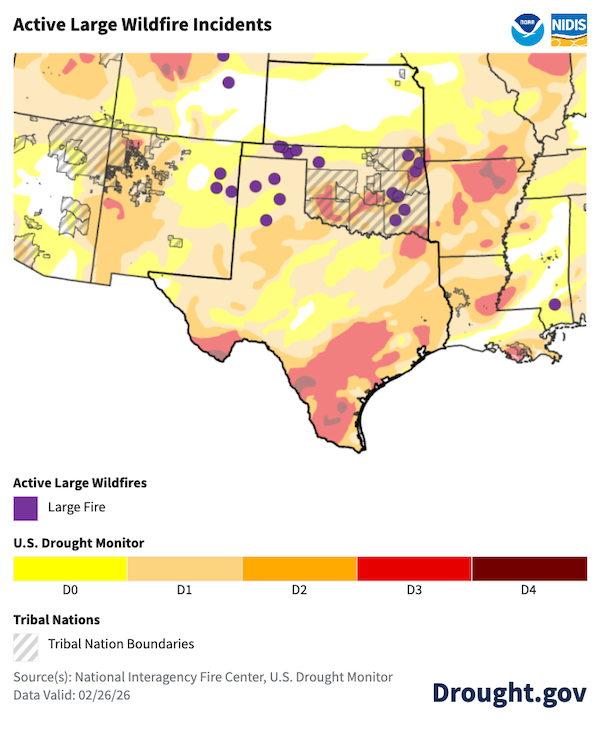
- Kansas, Oklahoma, and Texas are dealing with major wildland fires this winter.
- Fire season in the southern High Plains usually peaks from February to April, mostly due to dormant grasses and seasonably low precipitation through the winter months. Dry and warm conditions this season were additional factors to the normally higher fire danger.
- The Ranger Road Fire is the largest U.S. wildfire in 2026, so far. It ignited on February 17, 2026, near Beaver, Oklahoma, and exploded in size due to extreme 65+ mph wind gusts and dry grasslands.
- The fire burned 283,283 acres (442.6 square miles) in Beaver and Harper Counties (Oklahoma) and Clark, Comanche, and Meade Counties (Kansas).
- Agricultural impacts include damaged pasture land and fences and the loss of hundreds of livestock. The Oklahoma Cattlemen’s Association has established a relief fund for fire-affected producers.
- The mesonet site in Ashland, Kansas, was burned by this fire, but it was quickly brought back online.
- As of February 25, 2026, the Texas A&M Forest Service reported 60 active fires in Texas (most are contained), and outdoor burn bans have been established in 172 Texas counties.
Wildfires Burn Across the Texas Panhandle, Oklahoma, and Southern Kansas
60-Day Precipitation Near 0 Inches for Far South Texas, Below 25th Percentile for the Panhandles Region
High Evaporative Demand Compounds Existing Dry Conditions
Soil Moisture Across Texas, Oklahoma, and Eastern Kansas Is Below the 10th Percentile for February
Outlooks and Potential Impacts in the Southern Plains
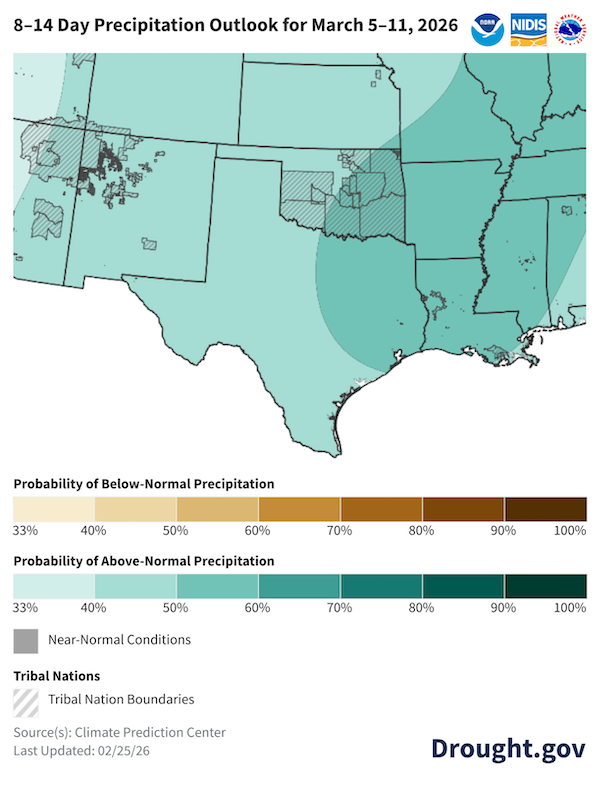
- The National Weather Service Climate Prediction Center’s 6-10 and 8-14 day outlooks favor warm and possibly wet weather across the Southern Plains, signaling a pattern shift in early March. Parts of central and eastern Oklahoma should see some short-term drought improvement from this shift.
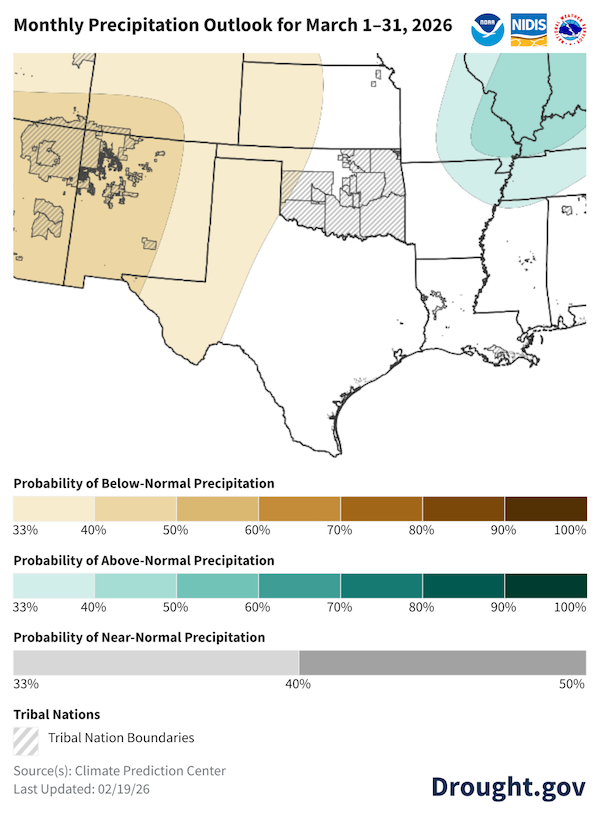
- March climate outlooks for the Southern Plains show slightly elevated chances of below-normal precipitation for the western High Plains area with near equal chances of above-, near-, or below-normal precipitation elsewhere. Above-normal temperatures for the month are likely across the whole region.
- Spring is typically a wetter season than winter across the Southern Plains states, and spring weather patterns can make or break a drought. The March to May outlooks show below-normal precipitation is most likely (40-50% chance) for far western Texas, western Kansas, and the Oklahoma and Texas Panhandles. A warm spring is likely (more than 40% chance) for most of Texas with lower odds (30-40%) for Oklahoma and Kansas.
- The National Weather Service Climate Prediction Center’s seasonal drought outlooks and global climate patterns favor drought persistence along the Rio Grande and drought expansion for far western Texas through spring.
- A La Niña Advisory is on its way out.
- La Niña conditions—which historically increase chances of dry winters in the Southern Plains—are waning and expected to transition to El Niño–Southern Oscillation (ENSO) neutral very soon, with ENSO-neutral conditions likely persisting through the summer.
- An El Niño pattern is possible by late summer or early fall. El Niño has the strongest influence during the winter months, usually (but not always) bringing wet weather to Texas. Sometimes, when El Niño is present in the summer, there is an eastward shift to the Southwest Monsoon.
Wet Weather in Early March Should Bring Short-Term Drought Improvement
March, as a Whole, Does Not Strongly Favor Wetter or Drier Conditions
Additional Resources
Recent Reports
- Southern Plains Drought Assessment 2020-2025
- Quarterly Climate Impacts and Outlook for the Southern Region - December 2025
Additional Resources by State
- More local information is available from the following resources:
- Your state climatologist
- Your state page on Drought.gov
- National Weather Service Drought Information Statements:
- February, 20, 2026: Brownsville, Texas
- February 19, 2026: Lake Charles, Louisiana
- February 12, 2026: Shreveport, Louisiana
- February 6, 2026: Midland/Odessa, Texas
- February 6, 2026: Tulsa, Oklahoma
- February 6, 2026: Fort Worth/Dallas, Texas
- February 6, 2026: Houston/Galveston, Texas
- February 5, 2026: Austin/San Antonio, Texas
- February 4, 2026: Corpus Christi, Texas
- February 3, 2026: El Paso, Texas/Santa Teresa, New Mexico
- More state and regional information is available from the following resources:
- Kansas: Climate and Drought in Kansas; Kansas Water Office; State Climate Office
- Oklahoma: Oklahoma Water Resources Board | Drought Monitoring; Oklahoma Mesonet Drought Tools; State Climate Office
- Texas: Texas Water Development Board | Drought; Texas Commission on Environmental Quality | Drought in Texas; Drought Dashboard: Water Data for Texas; Water Data for Texas | Texas Reservoirs; State Climate Office
- Regional: Southern Regional Climate Center, High Plains Regional Climate Center; Southern Climate Impacts Planning Program (SCIPP)
- To report or view local drought impact information:
Prepared By
Joel Lisonbee
Cooperative Institute for Research in Environmental Sciences/University of Colorado Boulder and NOAA’s National Integrated Drought Information System, Southern Plains Drought Early Warning System
John Nielsen-Gammon
Office of the Texas State Climatologist, Southern Regional Climate Center, Texas A&M University
Gary McManus
Oklahoma Climatological Survey, State Climatologist
Matt Sittel
Kansas State Climate Office
This Drought Status Update is issued in partnership between the National Oceanic and Atmospheric Administration (NOAA) and partners to communicate a potential area of concern for drought expansion and/or development within the Southern Plains Drought Early Warning System region based on recent conditions and the upcoming forecast. NIDIS and its partners will issue future Drought Status Updates as conditions evolve. NIDIS is an interagency program within the Climate Program Office, which is part of NOAA’s Office of Oceanic and Atmospheric Research.