May Storms Bring Relief, but Not Removal, of Southern Plains Drought
Key Points
- Western Texas, Oklahoma, and Kansas face significant drought challenges across multiple regions, affecting cropland, rangelands and water supplies, and increasing wildfire risk.
- This year’s winter wheat yield came up very short, creating a billion-dollar deficit in production.
- Recent rain in the eastern stretches of the region improved conditions, but did not eliminate long-term drought.
- A significant multi-day storm system already in progress should provide widespread rainfall to the eastern half of the Southern Plains states.
- This precipitation will provide relief to drought-affected areas in eastern and southern Texas, eastern Oklahoma, southern Arkansas, and northern Louisiana.
- The High Plains, in the west, will also get some rain from this storm, but will remain relatively dry. Drought is expected to persist.
- Long-range forecasts suggest that temperatures are likely to continue to average above normal over the next three months (May–July). There are near equal chances for above- or below-normal precipitation during this time.
- Long-term drought conditions in eastern Texas are expected to improve, but remain. Long-term drought in western Texas, Oklahoma, and Kansas will likely persist through summer.
- A strong El Niño event is expected to bring a wetter and cooler winter. Historically, the summer before an El Niño winter experiences less tropical storm activity observed over the Gulf.
This update is based on data available as of Tuesday, May 19, 2026 at 8:00 a.m. CT. We acknowledge that conditions are evolving.
Current drought conditions in the Southern Plains, according to the May 12 U.S. Drought Monitor. The U.S. Drought Monitor depicts the location and intensity of drought across the country using 5 classifications: Abnormally Dry (D0), showing areas that may be going into or are coming out of drought, and four levels of drought (D1–D4).
The U.S. Drought Monitor is a joint effort of the National Drought Mitigation Center, U.S. Department of Agriculture, National Oceanic and Atmospheric Administration, and National Aeronautics and Space Administration.
A drought index combines multiple drought indicators (e.g., precipitation, temperature, soil moisture) to depict drought conditions. For some products, like the U.S. Drought Monitor, authors combine their analysis of drought indicators with input from local observers. Other drought indices, like the Standardized Precipitation Index (SPI), use an objective calculation to describe the severity, location, timing, and/or duration of drought.
Learn MorePeriods of drought can lead to inadequate water supply, threatening the health, safety, and welfare of communities. Streamflow, groundwater, reservoir, and snowpack data are key to monitoring and forecasting water supply.
Learn MoreDrought can reduce the water availability and water quality necessary for productive farms, ranches, and grazing lands, resulting in significant negative direct and indirect economic impacts to the agricultural sector. Monitoring agricultural drought typically focuses on examining levels of precipitation, evaporative demand, soil moisture, and surface/groundwater quantity and quality.
Learn MoreU.S. Drought Monitor Categories
D0 - Abnormally Dry
Abnormally Dry (D0) indicates a region that is going into or coming out of drought, according to the U.S. Drought Monitor.
D1 – Moderate Drought
Moderate Drought (D1) is the first of four drought categories (D1–D4), according to the U.S. Drought Monitor.
D2 – Severe Drought
Severe Drought (D2) is the second of four drought categories (D1–D4), according to the U.S. Drought Monitor.
D3 – Extreme Drought
Extreme Drought (D3) is the third of four drought categories (D1–D4), according to the U.S. Drought Monitor.
D4 – Exceptional Drought
Exceptional Drought (D4) is the most intense drought category, according to the U.S. Drought Monitor.
Total Area in Drought (D1–D4)
Percent area of the Southern Plains that is currently in drought (D1–D4), according to the U.S. Drought Monitor.
Current drought conditions in the Southern Plains, according to the May 12 U.S. Drought Monitor. The U.S. Drought Monitor depicts the location and intensity of drought across the country using 5 classifications: Abnormally Dry (D0), showing areas that may be going into or are coming out of drought, and four levels of drought (D1–D4).
The U.S. Drought Monitor is a joint effort of the National Drought Mitigation Center, U.S. Department of Agriculture, National Oceanic and Atmospheric Administration, and National Aeronautics and Space Administration.
The U.S. Drought Monitor is updated weekly on Thursday mornings, with data valid through the previous Tuesday morning.
A drought index combines multiple drought indicators (e.g., precipitation, temperature, soil moisture) to depict drought conditions. For some products, like the U.S. Drought Monitor, authors combine their analysis of drought indicators with input from local observers. Other drought indices, like the Standardized Precipitation Index (SPI), use an objective calculation to describe the severity, location, timing, and/or duration of drought.
Learn MorePeriods of drought can lead to inadequate water supply, threatening the health, safety, and welfare of communities. Streamflow, groundwater, reservoir, and snowpack data are key to monitoring and forecasting water supply.
Learn MoreDrought can reduce the water availability and water quality necessary for productive farms, ranches, and grazing lands, resulting in significant negative direct and indirect economic impacts to the agricultural sector. Monitoring agricultural drought typically focuses on examining levels of precipitation, evaporative demand, soil moisture, and surface/groundwater quantity and quality.
Learn MoreCurrent Conditions and Impacts for the Southern Plains
- A primarily agricultural drought has been impacting the region. For Oklahoma and northern Texas, this drought began in August 2025 and intensified over the winter and early spring. This drought has negatively impacted rangeland conditions and crop production.
- Winter wheat abandonment by Southern Plains state: 70% in Texas, 47% in Oklahoma, and 17% in Kansas.
- Of the acres harvested, yield in the Southern Plains states are down compared to last year by 24% in Texas, 26% in Oklahoma, and 27% in Kansas.
- The difference between expected production and actual production created a >$1 billion shortfall.
- Exceptional Drought (D4) appeared in Oklahoma and the Texas Panhandle for the first time since July 2023.
- Edwards Aquifer levels remain significantly below average and have been since 2022.
- On average, May and June are the wettest months of the year in the Southern Plains.
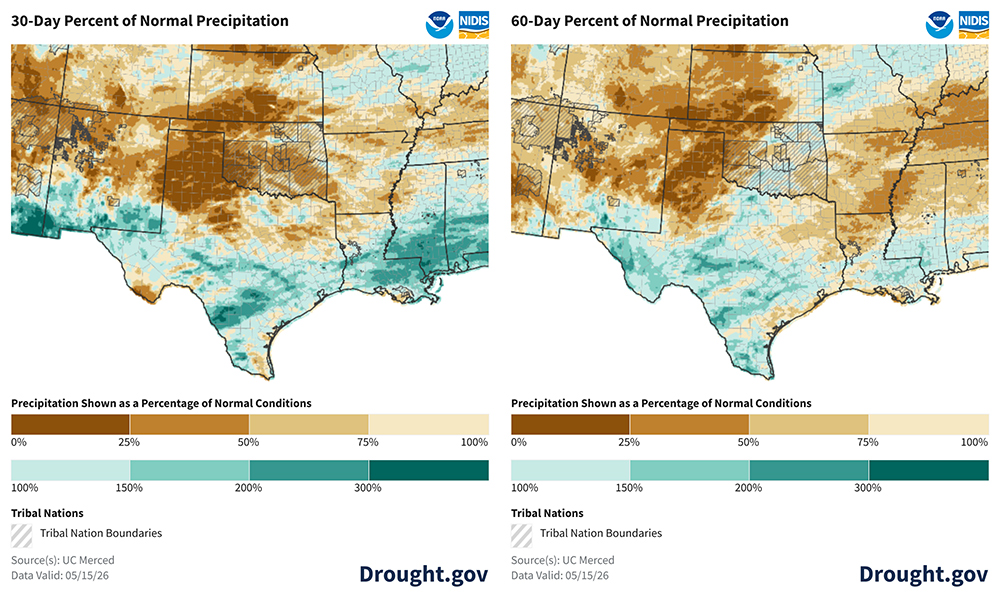
- Following a very dry March, April monthly precipitation returned to near normal for all three Southern Plains states, but most rain was in the eastern part of the region, allowing drought conditions to deteriorate in the west.
- Statewide average temperatures were high through April.
- Kansas: 3rd warmest April on record, 6.1 ºF above average
- Oklahoma: 5th warmest April on record, 5.7 ºF above average
- Texas: 7th warmest April on record, 5.0 ºF above average
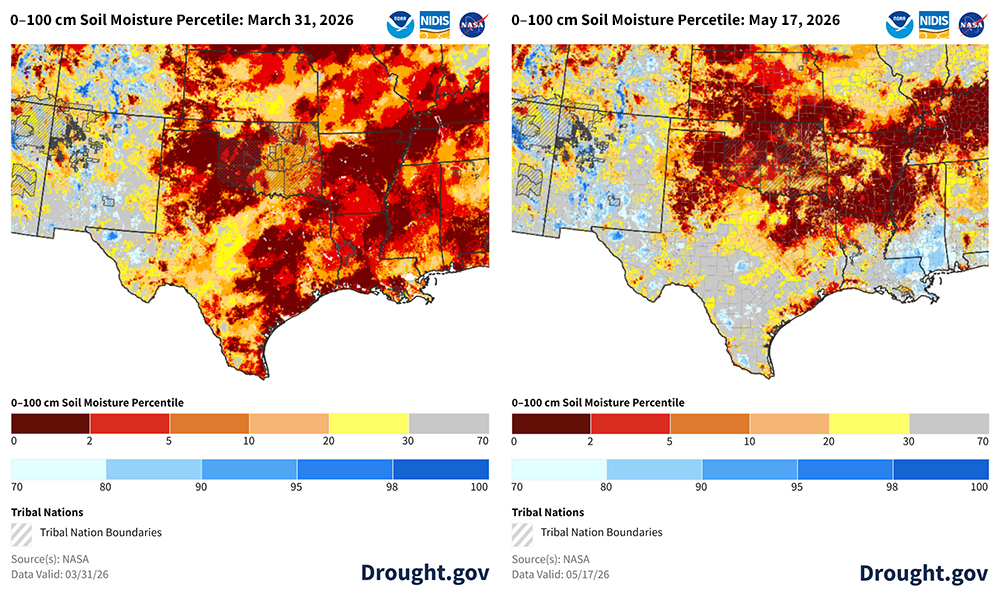
- Soil moisture across most of northern Texas, Oklahoma, and western Kansas is below the 10th percentile.
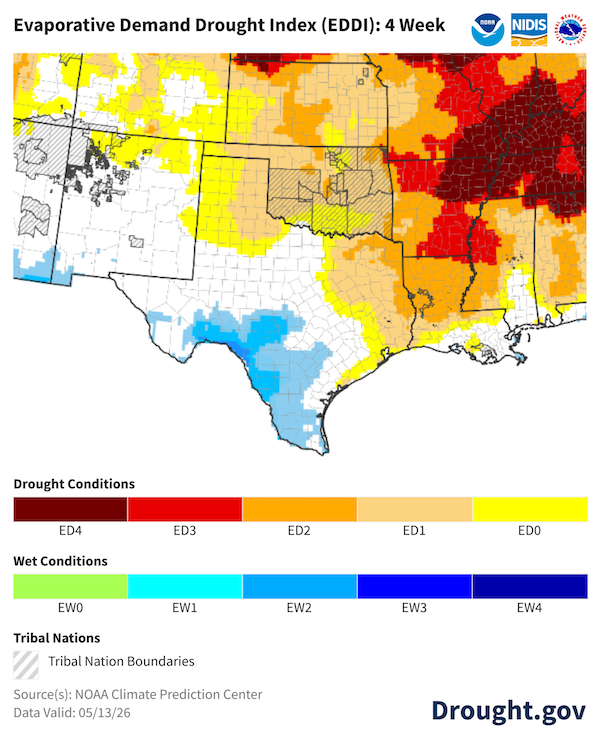
- The Evaporative Demand Drought Index (EDDI) remained high for Oklahoma and Kansas from mid-April through mid-May. Unusually high evaporative demand (the “thirst of the atmosphere”) can lead to drying of the landscape, even when precipitation has been near normal.
Precipitation Deficits Continue for Western Kansas, Oklahoma, and the Texas Panhandle
High Evaporative Demand Compounds Existing Dry Conditions for Oklahoma and Kansas
Soil Moisture Across Texas, Oklahoma, and Kansas Improved in April and May, but Not Everywhere
Outlooks and Potential Impacts in the Southern Plains
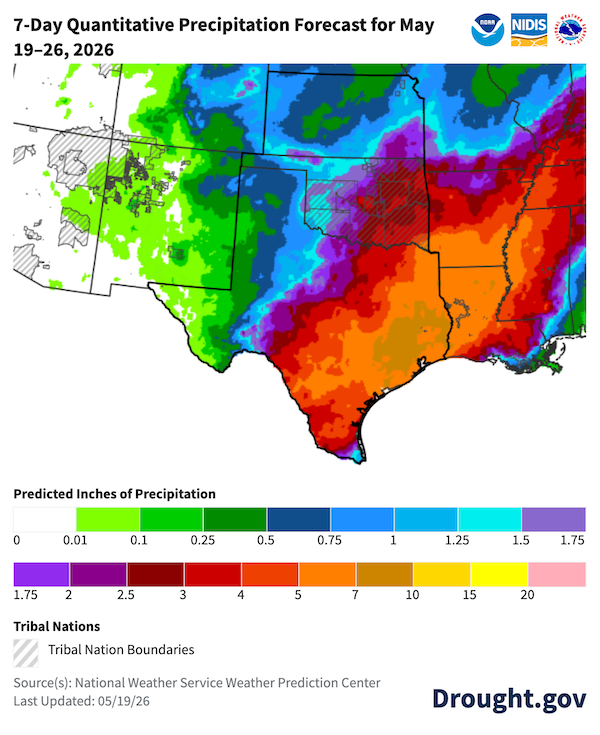
- A significant multi-day storm system this week (May 19-26) is bringing widespread rainfall to the eastern half of the Southern Plains states.
- 4 to 10 inches are forecast for drought-affected areas in eastern and southern Texas, eastern Oklahoma, southern Arkansas, and northern Louisiana.
- The High Plains, including western Kansas and the Texas and Oklahoma panhandles, will also get some rain from this storm, potentially over one inch in some locations. This will not be enough to make up for long-term precipitation deficits, and overall, drought in the High Plains is expected to persist.
- Far West Texas and New Mexico are expected to receive very little to no rainfall.
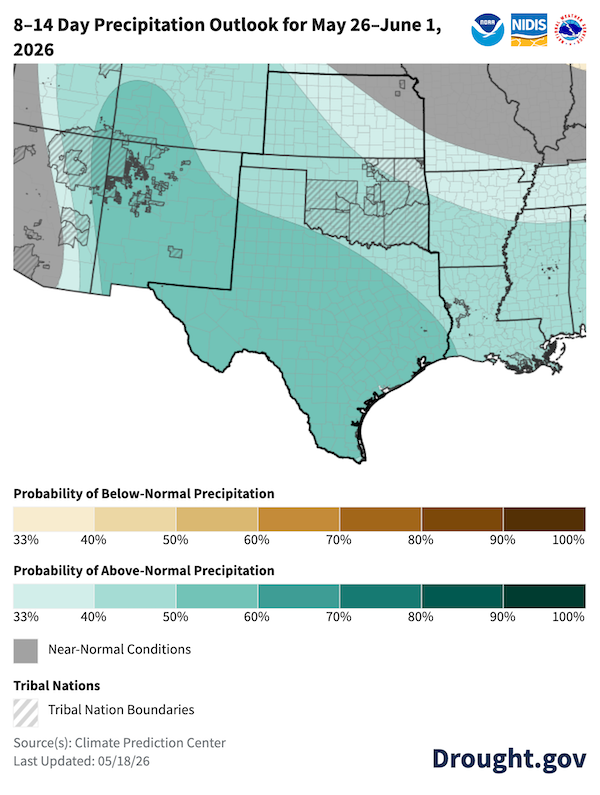
- The National Weather Service Climate Prediction Center’s 6-10 and 8-14 day outlooks favor wetter-than-normal weather across the Southern Plains.
- The May to July outlooks show below-normal precipitation is most likely (33-40% chance) for western and central Kansas, with odds favoring above-normal precipitation for Far West Texas. Above-average temperatures are likely (more than 40% chance) for most of the Southern Plains.
- An El Niño Watch is in place.
- El Niño has the strongest influence during the winter months, but can occasionally drive summer weather.
- El Niño conditions are usually associated with a cool, wet winter for Texas. Historically, there is not a dominant summertime weather pattern during developing El Niños.
- Learn more about what El Niño could mean for drought in the Southern Plains.
May Storms Should Bring Short-Term Drought Improvement for Eastern Texas and Oklahoma
Wet Weather in Late May Should Bring Continued Short-Term Drought Improvement
Additional Resources
Recent News and Reports
- March Snow Drought Update for the West
- New NOAA El Niño-Southern Oscillation Index Supports Drought Early Warning
- El Niño on the Horizon: Can the Warm Phase End Six Years of Drought in the Southern Plains of the U.S.?
- Measuring What Matters: Upper Missouri River Basin Studies Improve Drought and Flood Forecasts with Snow and Soil Moisture Data
Additional Resources by State
More local information is available from the following resources:
- Your state climatologist
- Your state page on Drought.gov:
- National Weather Service Drought Information Statements:
- Texas:
- May, 13, 2026: Brownsville, Texas
- May 8, 2026: Houston/Galveston, Texas
- May 7, 2026: Austin/San Antonio, Texas
- May 4, 2026: Corpus Christi, Texas
- May 4, 2026: El Paso TX/Santa Teresa, New Mexico
- April 17, 2026: Amarillo, Texas
- Oklahoma:
- April 30, 2026: Tulsa, Oklahoma
- Kansas:
- May 11, 2026: Wichita, Kansas
- May 6, 2026: Goodland, Kansas
- May 2, 2026: Dodge City, Kansas
- Louisiana:
- May 7, 2026: Lake Charles, Louisiana
- Texas:
More state and regional information is available from the following resources:
- Kansas: Climate and Drought in Kansas; Kansas Water Office; State Climate Office
- Oklahoma: Oklahoma Water Resources Board | Drought Monitoring; Oklahoma Mesonet Drought Tools; State Climate Office
- Texas: Texas Water Development Board | Drought; Texas Commission on Environmental Quality | Drought in Texas; Drought Dashboard: Water Data for Texas; Water Data for Texas | Texas Reservoirs; State Climate Office
- Regional: Southern Regional Climate Center, High Plains Regional Climate Center; Southern Climate Impacts Planning Program (SCIPP)
To report or view local drought impact information:
Prepared By
Joel Lisonbee
Cooperative Institute for Research in Environmental Sciences/University of Colorado Boulder and NOAA’s National Integrated Drought Information System, Southern Plains Drought Early Warning System
John Nielsen-Gammon and B.J. Baule
Office of the Texas State Climatologist, Southern Regional Climate Center, Texas A&M University
Matt Sittel
Kansas State Climate Office
This Drought Status Update is issued in partnership between the National Oceanic and Atmospheric Administration (NOAA) and partners to communicate a potential area of concern for drought expansion and/or development within the Southern Plains Drought Early Warning System region based on recent conditions and the upcoming forecast. NIDIS and its partners will issue future Drought Status Updates as conditions evolve. NIDIS is an interagency program within the Climate Program Office, which is part of NOAA’s Office of Oceanic and Atmospheric Research.